


Page 38 - Towards_a_New_Malaysia_The_2018_Election_and_Its_6146371_(z-lib.org)
P. 38
How Malaysia Voted in 2018                                    23

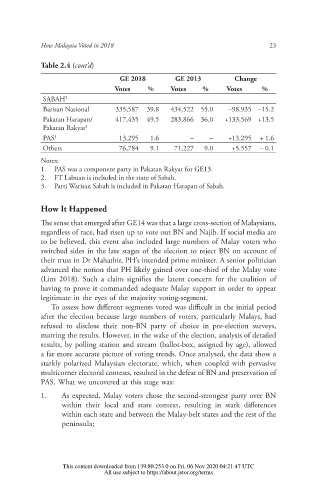
                  Table 2.4 (cont’d)
                                        GE 2018        GE 2013         Change
                                      Votes    %     Votes    %     Votes     %
                   SABAH 2
                   Barisan Nasional    335,587  39.8   434,522 55.0   –98,935 –15.2
                   Pakatan Harapan/    417,435  49.5   283,866 36.0   +133,569 +13.5
                   Pakatan Rakyat 3
                   PAS 1                13,295   1.6       –    –    +13,295  + 1.6
                   Others               76,784   9.1   71,227   9.0   +5,557  – 0.1
                  Notes:
                  1.  PAS was a component party in Pakatan Rakyat for GE13.
                  2.  FT Labuan is included in the state of Sabah.
                  3.  Parti Warisan Sabah is included in Pakatan Harapan of Sabah.


                  How It Happened

                   e sense that emerged after GE14 was that a large cross-section of Malaysians,
                  regardless of race, had risen up to vote out BN and Najib. If social media are
                  to be believed, this event also included large numbers of Malay voters who
                  switched sides in the late stages of the election to reject BN on account of
                  their trust in Dr Mahathir, PH’s intended prime minister. A senior politician
                  advanced the notion that PH likely gained over one-third of the Malay vote
                  (Lim 2018).  Such  a claim  signi es the  latent concern  for  the coalition  of
                  having to prove it commanded adequate Malay support in order to appear
                  legitimate in the eyes of the majority voting-segment.
                     To assess how di erent segments voted was di cult in the initial period
                  after the election because large numbers of voters, particularly Malays, had
                  refused to disclose their non-BN party of choice in pre-election surveys,
                  marring the results. However, in the wake of the election, analysis of detailed
                  results, by polling station and stream (ballot-box, assigned by age), allowed
                  a far more accurate picture of voting trends. Once analysed, the data show a
                  starkly polarized Malaysian electorate, which, when coupled with pervasive
                  multicorner electoral contests, resulted in the defeat of BN and preservation of
                  PAS. What we uncovered at this stage was:

                  1.    As expected, Malay voters chose the second-strongest party over BN
                        within their local and state context, resulting in stark di erences
                        within each state and between the Malay-belt states and the rest of the
                        peninsula;


                        This content downloaded from 139.80.253.0 on Fri, 06 Nov 2020 04:21:47 UTC
                                   All use subject to https://about.jstor.org/terms

