


Page 70 - Towards_a_New_Malaysia_The_2018_Election_and_Its_6146371_(z-lib.org)
P. 70
Elite Fragmentation and Party Splits                          55

                  having captured 44 per cent of Malay votes, while PAS came in second with
                  34 per cent.  at elite-level rifts are mirrored in the fragmentation of Malay
                  voters among three major political actors—PH, UMNO, and PAS—poses a
                  serious challenge for the new PH government in pushing forward their reform
                  agenda.  ey will have to be sensitive to Malays’ demands and fears, as they
                  still do not command majority support within the community (see Ahmad
                  Fauzi and Che Hamdan’s chapter, this volume).


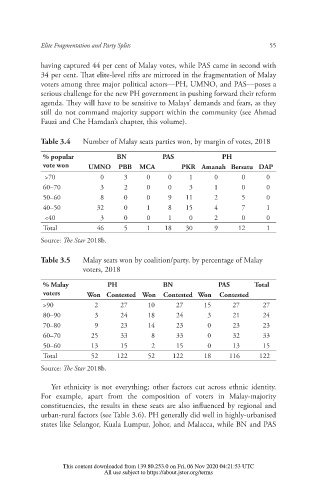
                  Table 3.4   Number of Malay seats parties won, by margin of votes, 2018
                   % popular           BN          PAS             PH
                   vote won    UMNO    PBB   MCA        PKR Amanah Bersatu DAP
                    >70            0     3     0     0     1     0       0     0
                   60–70           3     2     0     0     3     1       0     0
                   50–60           8     0     0     9   11      2       5     0
                   40–50         32      0     1     8   15      4       7     1
                    <40            3     0     0     1     0     2       0     0
                   Total         46      5     1    18   30      9     12      1

                  Source:  e Star 2018b.

                  Table 3.5   Malay seats won by coalition/party, by percentage of Malay
                              voters, 2018

                   % Malay          PH             BN             PAS       Total
                   voters      Won Contested Won   Contested Won  Contested
                   >90           2      27     10      27     15       27      27
                   80–90         3      24     18      24       3      21      24
                   70–80         9      23     14      23       0      23      23
                   60–70        25      33       8     33       0      32      33
                   50–60        13      15       2     15       0      13      15
                   Total        52     122     52     122     18     116     122
                  Source:  e Star 2018b.

                     Yet ethnicity is not everything; other factors cut across ethnic identity.
                  For example, apart from the composition of voters in Malay-majority
                  constituencies, the results in these seats are also in uenced by regional and
                  urban-rural factors (see Table 3.6). PH generally did well in highly-urbanised
                  states like Selangor, Kuala Lumpur, Johor, and Malacca, while BN and PAS


                        This content downloaded from 139.80.253.0 on Fri, 06 Nov 2020 04:21:53 UTC
                                   All use subject to https://about.jstor.org/terms

