


Page 62 - Microsoft Word - Bogra-01-Community-11
P. 62
3.9.1 Background: Shajahanpur Upazila came into existence on 3 June 2002. Before in caption as
an independent upazila it was a part it of Bogra Sadar Upazila. It is said that during Mughal period
emperor Shahjahan sent some soldiers to build a check post for protecting the area from robbers. In
consequence of which the area became popularly known as Shahjahanpur. The upazila was
declared as Majhira Upazila in 3 June 2001. It was renamed as Shahjahanpur on 2 March 2005.

3.9.2 Area and location: This upazila occupies an area of 221.69 sq. km.. It is located between
24o41' and 24o50' north latitudes and between 89o16' and 89o30' east longitudes. It is bounded on the
north by Bogra Sadar Upazila, south by Sherpur Upazila and Nandigram Upazila, east by Gabtali
Upazila and Dhunat Upazila and west by Nandigram Upazila and Kahaloo Upazila.

3.9.3 Administrative/Geographic Unit: The upazila consists of 1 full and 2 (part) wards of Bogra
Paurashava and 16 mahallas, 9 unions, 120 populated mauzas and 166 villages. The average size of
population of each ward and mahalla are 16862 and 2810 respectively. On the other hand, the
average size of population of each union, mauza and village are 20697, 1897 and 1371 respectively.

3.9.4 Housing and Household Characteristics: In the upazila, there are 72685 households.
Distribution of household by type shows that there are 99.50% general unit, 0.15% institutional and
0.35% other unit.

     • Household Size: The average household size (General) for the upazila is 3.9 persons, for
          rural area the size is slightly lower i.e. 3.8 and for urban area the size is slightly higher i.e. 4.0.

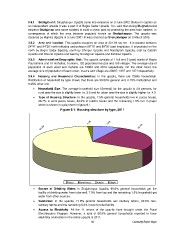
     • Type of Housing Structure: In the upazila, 7.5% general households live in pucca house,
          26.7% in semi-pucca house, 64.3% in kutcha house and the remaining 1.5% live in jhupri
          which is shown in a pie-chart in figure 9.1.

                               Figure 9.1: Housing structure by type, 2011

64.3%
                                                              1.5%
                                                                                        7.5%

                                                                                                                                  26.7%

Pucca  Semi‐Pucca  Kutcha  Jhupri

• Source of Drinking Water: In Shajahanpur Upazila, 90.6% general households get the
     facility of drinking water from tube-well, 7.9% from tap and the remaining 1.5% household get
     water from other sources.

• Sanitation: In the upazila, 71.8% general households use sanitary latrine, 22.6% non-
     sanitary latrine and the remaining 5.6% have no toilet facility.

• Access to Electricity: All the 11 unions of the upazila have brought under the Rural
     Electrification Program. However, a total of 66.9% general households reported to have
     electricity connection in the entire upazila in 2011.
                                                                    44 Community Report: Bogra

