


Page 757 - (ISC)² CISSP Certified Information Systems Security Professional Official Study Guide
P. 757
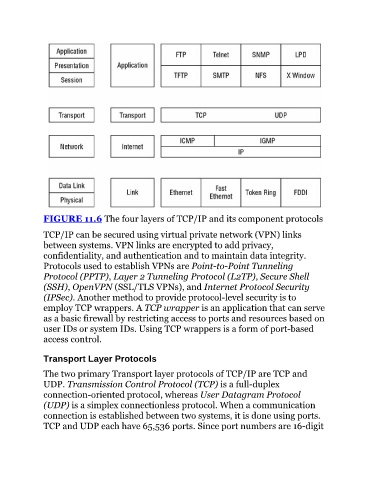
FIGURE 11.6 The four layers of TCP/IP and its component protocols


               TCP/IP can be secured using virtual private network (VPN) links
               between systems. VPN links are encrypted to add privacy,
               confidentiality, and authentication and to maintain data integrity.
               Protocols used to establish VPNs are Point-to-Point Tunneling
               Protocol (PPTP), Layer 2 Tunneling Protocol (L2TP), Secure Shell
               (SSH), OpenVPN (SSL/TLS VPNs), and Internet Protocol Security
               (IPSec). Another method to provide protocol-level security is to

               employ TCP wrappers. A TCP wrapper is an application that can serve
               as a basic firewall by restricting access to ports and resources based on
               user IDs or system IDs. Using TCP wrappers is a form of port-based
               access control.


               Transport Layer Protocols

               The two primary Transport layer protocols of TCP/IP are TCP and
               UDP. Transmission Control Protocol (TCP) is a full-duplex

               connection-oriented protocol, whereas User Datagram Protocol
               (UDP) is a simplex connectionless protocol. When a communication
               connection is established between two systems, it is done using ports.
               TCP and UDP each have 65,536 ports. Since port numbers are 16-digit

