


Page 761 - (ISC)² CISSP Certified Information Systems Security Professional Official Study Guide
P. 761
acknowledge packet is sent is known as the transmission window.
               Data flow is controlled through a mechanism called sliding windows.

               TCP is able to use different sizes of windows (in other words, a
               different number of transmitted packets) before sending an
               acknowledgment. Larger windows allow for faster data transmission,
               but they should be used only on reliable connections where lost or
               corrupted data is minimal. Smaller windows should be used when the
               communication connection is unreliable. TCP should be employed
               when the delivery of data is required. Sliding windows allow this size

               to vary dynamically because the reliability of the TCP session changes
               while in use. In the event that all packets of a transmission window
               were not received, no acknowledgment is sent. After a timeout period,
               the sender will resend the entire transmission window set of packets
               again.

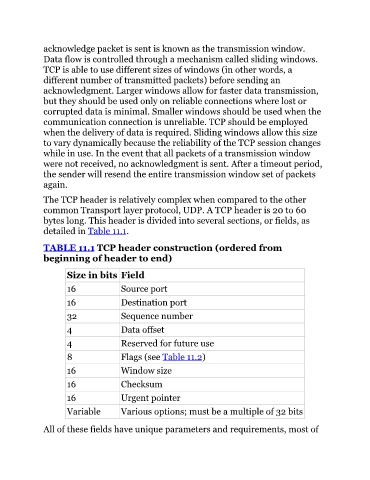
               The TCP header is relatively complex when compared to the other
               common Transport layer protocol, UDP. A TCP header is 20 to 60

               bytes long. This header is divided into several sections, or fields, as
               detailed in Table 11.1.

               TABLE 11.1 TCP header construction (ordered from
               beginning of header to end)


                       Size in bits Field

                       16                Source port

                       16                Destination port
                       32                Sequence number

                       4                 Data offset

                       4                 Reserved for future use

                       8                 Flags (see Table 11.2)

                       16                Window size
                       16                Checksum

                       16                Urgent pointer

                       Variable          Various options; must be a multiple of 32 bits


               All of these fields have unique parameters and requirements, most of

