


Page 762 - (ISC)² CISSP Certified Information Systems Security Professional Official Study Guide
P. 762
which are beyond the scope of the CISSP exam. However, you should
               be familiar with the details of the flags field. The flags field can contain

               a designation of one or more flags, or control bits. These flags indicate
               the function of the TCP packet and request that the recipient respond
               in a specific manner. The flags field is 8 bits long. Each of the bit
               positions represents a single flag, or control setting. Each position can
               be set on with a value of 1 or off with a value of 0. There are some
               conditions in which multiple flags can be enabled at once (in other
               words, the second packet in the TCP three-way handshake when both

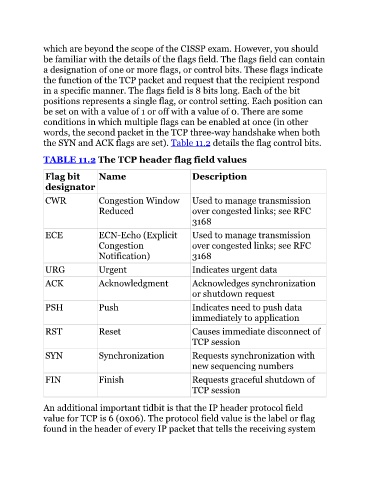
               the SYN and ACK flags are set). Table 11.2 details the flag control bits.

               TABLE 11.2 The TCP header flag field values


                Flag bit          Name                           Description
                designator

                CWR               Congestion Window              Used to manage transmission
                                  Reduced                        over congested links; see RFC
                                                                 3168

                ECE               ECN-Echo (Explicit             Used to manage transmission
                                  Congestion                     over congested links; see RFC
                                  Notification)                  3168

                URG               Urgent                         Indicates urgent data

                ACK               Acknowledgment                 Acknowledges synchronization
                                                                 or shutdown request

                PSH               Push                           Indicates need to push data
                                                                 immediately to application

                RST               Reset                          Causes immediate disconnect of
                                                                 TCP session
                SYN               Synchronization                Requests synchronization with

                                                                 new sequencing numbers

                FIN               Finish                         Requests graceful shutdown of
                                                                 TCP session

               An additional important tidbit is that the IP header protocol field

               value for TCP is 6 (0x06). The protocol field value is the label or flag
               found in the header of every IP packet that tells the receiving system

