


Page 146 - sarah-simblet_sketch-book-for-the-artist
P. 146
PORTRAITURE146 Drawing Portraits

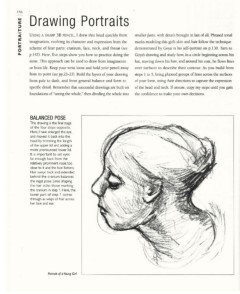
             USING A SHARP 3 B PENCIL, I drew this head quickly from          smaller parts, with details brought in last of all. Phrased tonal
             imagination, evolving its character and expression from the      marks modeling this girls skin and hair follow the technique
             scheme of four parts: cranium, face, neck, and throat (see       demonstrated by Goya in his self-portrait on p. 130. Turn to
             p. 142). Here, five steps show you how to practice doing the     Goya's drawing and study how, in a circle beginning across his
             same. This approach can be used to draw from imagination         hat, moving down his hair, and around his coat, he flows lines
             or from life. Keep your wrist loose and hold your pencil away    over surfaces to describe their contour. As you build from
             from its point (see pp.22-23). Build the layers of your drawing  steps 1 to 5, bring phrased groups of lines across the surfaces
             from pale to dark, and from general balance and form to          of your form, using their directions to capture the expression
             specific detail. Remember that successful drawings are built on  of the head and neck. If unsure, copy my steps until you gain
             foundations of "seeing the whole," then dividing the whole into  the confidence to make your own decisions.

             BALANCED POSE

             This drawing is the final stage
             of the four steps opposite.
             Here, I have enlarged the eye,
             and moved it back into the
             head by trimming the length
             of the upper lid and adding a
             more pronounced lower lid.
             It is important to set eyes
             far enough back from the
             relatively prominent nose; too
             close to it and the face flattens.
             Hair swept back and extended
             behind the cranium balances
             the regal pose. Lines shaping
             the hair echo those marking
             the cranium in step 1. Here, the
             lower part of step 1 comes
             through as wisps of hair across
             her face and ear

             Portrait of a Young Girl

