


Page 142 - sarah-simblet_sketch-book-for-the-artist
P. 142
PORTRAITURE142

              Head and Neck

             THE HEAD AND NECK are best conceived as one unit                       vertebrae—adjusts and holds the angle and expression of
             arranged in four parts: cranium, face, neck, and throat.               the head. The throat is delicate, hard, and lumpy to the
             Each is of equal importance. The cranium is essentially                touch, formed of cartilaginous rings, glands, thin muscles,
             egg-shaped and pivots on the first vertebra. The face is               and looser skin. Framing the throat, two columnar neck
             suspended beneath, like a softly curved triangle. The n e c k —        muscles (sternomastoids) project the head forward and
             a powerful, shapely column of layered muscles rigged to                also turn it to the opposite side.

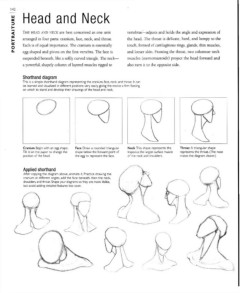
             Shorthand diagram

             This is a simple shorthand diagram representing the cranium, face, neck, and throat. It can
             be learned and visualized in different positions very easily, giving the novice a firm footing
             on which to stand and develop their drawings of the head and neck.

             Cranium Begin with an egg shape.    Face Draw a rounded triangular     Neck This shape represents the         Throat A triangular shape
             Tilt it on the paper to change the  shape below the forward point of   trapezius; the largest surface muscle  represents the throat. (The nose
             position of the head.               the egg to represent the face.     of the neck and shoulders.             makes the diagram clearer)

             Applied shorthand

             After copying the diagram above, animate it. Practice drawing the
             cranium at different angles, add the face beneath, then the neck,
             shoulders, and throat. Shape your diagrams so they are more lifelike,
             but avoid adding detailed features too soon.

