


Page 204 - sarah-simblet_sketch-book-for-the-artist
P. 204
EARTH AND THE ELEMENTS204                                              depositing particles in the grain of paper.                    LIFTING OUT
                                                                       Smooth paper accepts few particles, resulting
   Charcoal                                                            in a pale line. Rough paper can be loaded,                     This technique is a very easy
                                                                       and offers a rich, black finish.                               method of drawing a crisp,
            CHARCOAL IS PRODUCED from wood baked                                                                                      fine, white line into the black-
            slowly without exposure to air, so it chars                                                                               or grayness of willow charcoal.
            black as opposed to igniting and turning                                                                                  It allows you greater precision
            to ash. Willow is the most common wood.                                                                                   in your mark-making than if
                                                                                                                                      you rub away the charcoal
                                                                                                                                      with an eraser.

                        Artists have also used lime, beech, maple,     Charcoal naturally glistens. It can be

                        vine, and plum. Bundles of twigs were          made duller, blacker, and more indelible

                        traditionally sealed into earthenware jars     by soaking it in linseed oil. Alternatively, you

                        or wet clay and heated slowly and intensely    can purchase machine-made compressed

                        in a fire or kiln.                             charcoal. As its name implies, it is compressed

                        Charcoal lifts away from paper easily with     and molded at high pressure, resulting in

                        the very light touch of an eraser, a piece of  a stick that gives a blacker, harder line. It

                        fresh bread, the heel of your hand, a rag,     does not erase easily, leaving undertraces                     1Suspend a length of masking
                        feather, or fingertip. Lines are achieved by   of first thoughts.                                                       tape, sticky side down,
                                                                                                                                       between your middle finger and
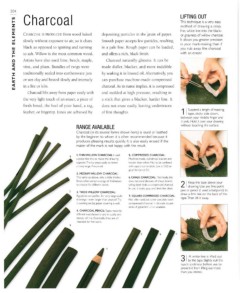
                                            RANGE AVAILABLE                                                                            thumb. Hold it over your drawing

                                            Charcoal (in its several forms shown here) is loved or loathed                             without touching the surface.
                                            by the beginner to whom it is often recommended because it
                                            produces pleasing results quickly. It is also easily erased if the
                                            maker of the mark is not happy with the result.

                                            1. THIN WILLOW CHARCOAL: I used              5. COMPRESSED CHARCOAL:                      2 Keep the tape above your
                                            a piece like this to make the drawing        Machine-made, cylindrical, blacker, and               drawing. Use any fine-point
                                            opposite. The tip snaps easily to renew      heavier than willow. Not to be confused      pen or pencil (I used a ballpoint) to
                                            a sharp edge if required.                    with square conte sticks (see p. 162) or     draw a firm line on the back of the
                                                                                         graphite (see p.54).                         tape. Then lift it away.
                                            2. MEDIUM W I L L O W CHARCOAL:
                                            The same as above, only a little thicker.    6. CHALK CHARCOAL: Technically, this
                                            Boxes often contain a range of thicknesses   does not exist. Beware of cheap brands
                                            to choose for different needs.               selling dyed chalk as compressed charcoal.
                                                                                         In use, it looks gray and feels like chalk.
                                            3. THICK W I L L O W CHARCOAL:
                                            Big pieces are perfect for very large-scale  7. SQUARE COMPRESSED CHARCOAL:
                                            drawings—even larger than yourself. Try      Not often sold, but some specialists stock
                                            itworking on big paper covering a wall.      compressed charcoal in delicate square
                                                                                         sticks. A great find when available.
                                            4. CHARCOAL PENCIL: Types made by
                                            different manufacturers vary in quality and
                                            density of line. Essentially, they are all
                                            intended for fine work.

                                                                                                                                      3 A white line is lifted out
                                                                                                                                               by the tape. Slightly dull the
                                                                                                                                      tape's stickiness before use to
                                                                                                                                      prevent it from lifting out more
                                                                                                                                      than you intend.

