


Page 206 - sarah-simblet_sketch-book-for-the-artist
P. 206
EARTH AND THE ELEMENTS206                                               p p . 9 8 - 9 9 we noted that in response to visual stimulus,
                                                                        our brains search for nameable things and will perceive
   Landscapes                                                           complete pictures from very little information. Ironically,
                                                                        the less you describe, the more you encourage the viewer's
           TREES ALONE OFFER MARVELOUS shapes to draw. They             imagination to join in and see. Excessive detail can be
           are also good markers of receding space, especially          admired for its skill and achievement, but is often less
           when making first excursions into aerial perspective.        evocative and engaging. At its worst, it results in flat planes
           This term simply means that as land rolls away into the      of clutter. To experiment with drawing landscapes and the
           distance, details blur and colors grow paler and bluer.      use of charcoal, pack your materials (as advised below) and
           It is the visible effect of the atmosphere between where     set off for a local view or your nearest arboretum. Don't
           you stand and what you see in the distance.                  worry if it is cloudy: clouds add drama and perspective
                                                                        and make good subjects in themselves (see pp.212-13).
               Landscape drawings are traditionally arranged in three
           parts: a detailed foreground; a less distinct middle ground
           composed of shapes and textures; and an abstract, hazy
           distance. Successful drawings often only suggest the
           qualities of the scene without overdescribing them. On

                                                                        MATERIALS

                                                                        Pack several thick and thin
                                                                        sticks of willow charcoal,
                                                                        a reel of masking tape, an
                                                                        eraser your drawing book
                                                                        or a board and paper fixative
                                                                        (or hairspray), and a cushion
                                                                        in a plastic bag to sit on. When
                                                                        you arrive, begin by marking
                                                                        out several small squares on
                                                                        your paper, to contain each
                                                                        of your compositions.

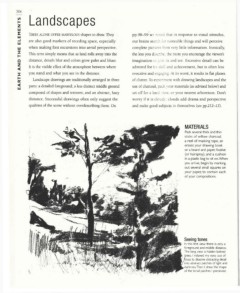
                                                                        Seeing tones

                                                                        In this first view there is only a
                                                                        foreground and middle distance.
                                                                        The long view is hidden behind
                                                                        trees. I relaxed my eyes out of
                                                                        focus to dissolve distracting detail
                                                                        into abstract patches of light and
                                                                        darkness. Then I drew the shape
                                                                        of the tonal patches I perceived.

