


Page 30 - sarah-simblet_sketch-book-for-the-artist
P. 30
ANIMALS30

  Movement

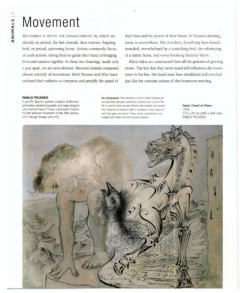
         M O V E M E N T IS OFTEN THE CHARACTERISTIC b y w h i c h w e   their lines and the power of their beasts. In Picasso's drawing,
                                                                         noise is everywhere. His powdery, dissolving faun kneels
         identify an animal: the fast cheetah, slow tortoise, flapping   stranded, overwhelmed by a screeching bird, the whinnying
         bird, or proud, quivering horse. Artists commonly focus         of a frantic horse, and waves breaking distantly below.
         on such actions, taking them to guide their hand in bringing
         form and essence together. In these two drawings, made only         Klee's riders are constructed from all the gestures of greeting
         a year apart, we see semi-abstract, flattened animals composed  mules. The fact that they never stand still influences the move-
         almost entirely of movement. Both Picasso and Klee have         ment in his line. His hand must have shuddered and twitched
         enclosed their subjects to compress and amplify the speed of    just like the constant actions of this humorous meeting.

         PABLO PICASSO                                     Ink and gouache This drawing is made in black Chinese ink        Faune, Cheval et Oiseau
                                                           and gouache (opaque watercolor) applied with a brush. The
         A prolific Spanish painter sculptor, draftsman,   ink is used to make sharply defined solid, hooked, and scrolled  1936
         printmaker ceramicist graphic and stage designer  lines. Gouache is brushed softly in translucent hazy layers of   173/8 x 211/4 in ( 4 4 0 x 5 4 0 m m )
         who lived in France. Picasso cofounded Cubism,    cool blue, gray, and brown. These media complement and           PABLO PICASSO
         the first abstract movement of the 20th century,  amplify each other with their brilliant contrast.
         with George Braque (see p90).

