


Page 23 - PESY Vol 7 No 4
P. 23
PESY: Print ISSN 2231-1394, Online ISSN 2278-795X                                                                    Vol. 7 No 4


                                                      TABLE - I (A)
                     ADJUSTED FINAL MEAN DIFFERENCE ON SURVICAL PAIN TEST
                            OF THREE EXPERIMENTAL GROUPS IN ANALYSIS OF
                               COVARIANCE AND SCHEFFE’S POST – HOC TEST
                                  Ex – I      Ex – II    Ex – III     M.D.           CI
                                  15.76        17.42         -         1.66         0.59
                                  15.76          -        24.41        8.65         0.59
                                     -         17.42       24.41       6.99         0.59
                                 * Significant at 0.05 level of confidence
                          The mean difference  between experimental group I and II, I and III, II
                    and III, were 1.66, 8.65 and 6.99 respectively. The mean difference 1.66, 8.65
                    and  6.99  were  seen  to  be  greater  than  the  confident  interval  value  of  0.59.
                    Hence the above comparisons were significant.
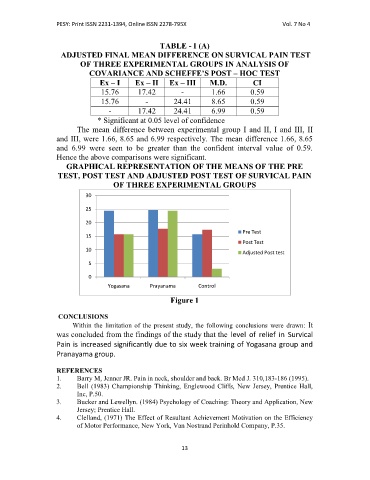
                       GRAPHICAL REPRESENTATION OF THE MEANS OF THE PRE
                    TEST, POST TEST AND ADJUSTED POST TEST OF SURVICAL PAIN
                                      OF THREE EXPERIMENTAL GROUPS

                             30
                             25

                             20
                                                                                 Pre Test
                             15
                                                                                 Post Test
                             10
                                                                                 Adjusted Post test
                              5
                              0
                                     Yogasana      Prayanama       Control

                                                         Figure 1

                     CONCLUSIONS
                         Within  the  limitation of  the  present  study,  the following  conclusions  were  drawn:  It
                    was concluded from the findings of the study that the  level  of  relief  in  Survical
                    Pain is increased significantly due to six week training of Yogasana group and
                    Pranayama group.

                    REFERENCES
                    1.    Barry M, Jenner JR. Pain in neck, shoulder and back. Br Med J. 310,183-186 (1995).
                    2.    Bell  (1983) Championship  Thinking,  Englewood  Cliffs,  New  Jersey,  Prentice  Hall,
                          Inc, P.50.
                    3.    Bucker and Lewellyn. (1984) Psychology of Coaching: Theory and Application, New
                          Jersey; Prentice Hall.
                    4.    Clelland, (1971) The Effect of Resultant Achievement Motivation on the Efficiency
                          of Motor Performance, New York, Van Nostrand Perinhold Company, P.35.


                                                             13

