


Page 20 - Vol 7 No 3 July September 2017
P. 20
PESY: Print ISSN 2231-1394, Online ISSN 2278-795X                                                                              Vol. 7 No 3

                        Table II (A) shows the Scheffe’s Post Hoc test for paired mean difference of Achievement
                 Motivation of different topography namely North, South, East, West and Central (Factor ‘A’). The
                 mean difference between North and South, North and East, North and West, North and Central,
                 South and East, South and West, South and Central, East and West, East and Central and West
                 and Central were 0.23, 1.27,2.87, 1.07, 1.04, 2.64, 0.84,1.6, 0.2 and 1.8. The Scheffe’s Critical
                 Difference Value was 187.98.
                        Hence the following comparisons were found not significant:
                        North  and  South,  north  and  East,  North  and  West,  North  and  Central,  South  and  East,
                 South and West, South and Central, East and West, East and Central and West and Central.
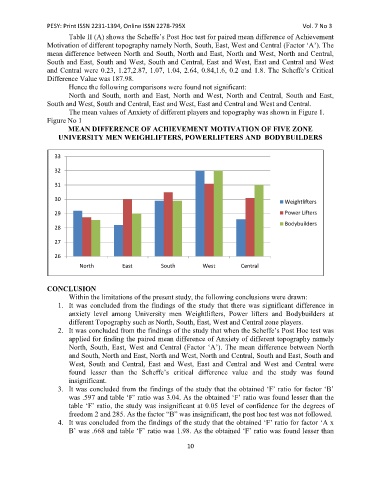
                        The mean values of Anxiety of different players and topography was shown in Figure 1.
                 Figure No 1
                        MEAN DIFFERENCE OF ACHIEVEMENT MOTIVATION OF FIVE ZONE
                    UNIVERSITY MEN WEIGHLIFTERS, POWERLIFTERS AND  BODYBUILDERS


                   33
                   32

                   31

                   30                                                                          Weightlifters

                   29                                                                          Power Lifters
                                                                                               Bodybuilders
                   28

                   27

                   26
                           North          East        South         West         Central


                 CONCLUSION
                        Within the limitations of the present study, the following conclusions were drawn:
                    1.  It was concluded from the findings of the study that there was significant difference in
                        anxiety  level  among  University  men  Weightlifters,  Power  lifters  and  Bodybuilders  at
                        different Topography such as North, South, East, West and Central zone players.
                    2.  It was concluded from the findings of the study that when the Scheffe’s Post Hoc test was
                        applied for finding the paired mean difference of Anxiety of different topography namely
                        North, South, East, West and Central (Factor ‘A’).  The mean difference between  North
                        and South, North and East, North and West, North and Central, South and East, South and
                        West,  South  and  Central,  East  and  West,  East  and  Central  and  West  and  Central  were
                        found  lesser  than  the  Scheffe’s  critical  difference  value  and  the  study  was  found
                        insignificant.
                    3.  It was concluded from the findings of the study that the obtained ‘F’ ratio for factor ‘B’
                        was .597 and table ‘F’ ratio was 3.04. As the obtained ‘F’ ratio was found lesser than the
                        table ‘F’ ratio, the study was insignificant at 0.05 level of confidence for the degrees of
                        freedom 2 and 285. As the factor “B” was insignificant, the post hoc test was not followed.
                    4.  It was concluded from the findings of the study that the obtained ‘F’ ratio for factor ‘A x
                        B’ was .668 and table ‘F’ ratio was 1.98. As the obtained ‘F’ ratio was found lesser than

                                                               10

