


Page 23 - Vol 7 No 3 July September 2017
P. 23
PESY: Print ISSN 2231-1394, Online ISSN 2278-795X                                                                              Vol. 7 No 3

                 calisthenics, stretching, sit-ups, pushups and medicine ball exercise with moderate intensity (60-
                 70%). Mean and standard deviation were calculated for LDL for each group. . ‘t’ test was used to
                 find  out the significance  difference  between  the  mean of  pre  and  post  test  of each  group  with
                 respect to Low density lipoprotein. Statistical significance was set to priority at 0.05 levels.
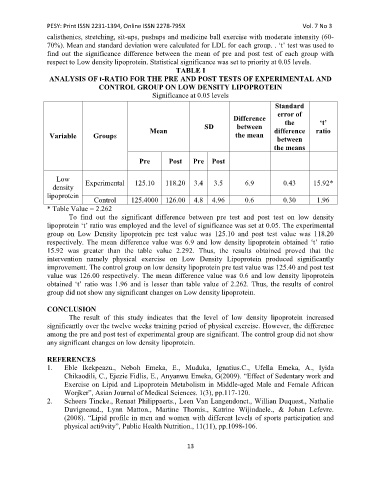
                                                           TABLE I
                 ANALYSIS OF t-RATIO FOR THE PRE AND POST TESTS OF EXPERIMENTAL AND
                                  CONTROL GROUP ON LOW DENSITY LIPOPROTEIN
                                                   Significance at 0.05 levels
                                                                                            Standard
                                                                                             error of
                                                                              Difference
                                                                                               the         ‘t’
                                                   Mean              SD        between      difference    ratio
                 Variable       Groups                                         the mean
                                                                                             between
                                                                                            the means
                                               Pre       Post    Pre  Post


                    Low
                  density    Experimental     125.10    118.20  3.4     3.5       6.9          0.43      15.92*
                 lipoprotein
                                Control     125.4000  126.00  4.8  4.96           0.6          0.30       1.96
                 * Table Value = 2.262
                        To  find  out  the  significant  difference  between  pre  test  and  post  test  on  low  density
                 lipoprotein ‘t’ ratio was employed and the level of significance was set at 0.05. The experimental
                 group  on  Low  Density  lipoprotein  pre  test  value  was  125.10  and  post  test  value  was  118.20
                 respectively.  The  mean  difference  value  was  6.9  and  low  density  lipoprotein  obtained  ‘t’  ratio
                 15.92  was  greater  than  the  table  value  2.292.  Thus,  the  results  obtained  proved  that  the
                 intervention  namely  physical  exercise  on  Low  Density  Lipoprotein  produced  significantly
                 improvement. The control group on low density lipoprotein pre test value was 125.40 and post test
                 value was  126.00 respectively. The mean difference value was 0.6 and low density  lipoprotein
                 obtained  ‘t’  ratio  was  1.96  and  is  lesser  than  table  value of  2.262.  Thus,  the  results  of  control
                 group did not show any significant changes on Low density lipoprotein.

                 CONCLUSION
                        The  result  of  this  study  indicates  that  the  level  of  low  density  lipoprotein  increased
                 significantly over the twelve weeks training period of physical exercise. However, the difference
                 among the pre and post test of experimental group are significant. The control group did not show
                 any significant changes on low density lipoprotein.

                 REFERENCES
                 1.   Eble  Ikekpeazu.,  Neboh  Emeka,  E.,  Muduka,  Ignatius.C.,  Ufella  Emeka,  A.,  Iyida
                      Chikaodili, C., Ejezie Fidlis, E., Anyanwu Emeka, G(2009). “Effect of Sedentary work and
                      Exercise on  Lipid and  Lipoprotein Metabolism in Middle-aged Male and Female African
                      Worjker”, Asian Journal of Medical Sciences. 1(3), pp.117-120.
                 2.   Scheers Tincke., Renaat Philippaerts., Leen Van Langendonct., Willian Duquest., Nathalie
                      Duvigneaud.,  Lynn  Matton.,  Martine  Thomis.,  Katrine  Wijindaele.,  &  Johan  Lefevre.
                      (2008). “Lipid profile in men and women with different levels of sports participation and
                      physical acti9vity”, Public Health Nutrition., 11(11), pp.1098-106.


                                                               13

