


Page 53 - Olympism in Socialism
P. 53
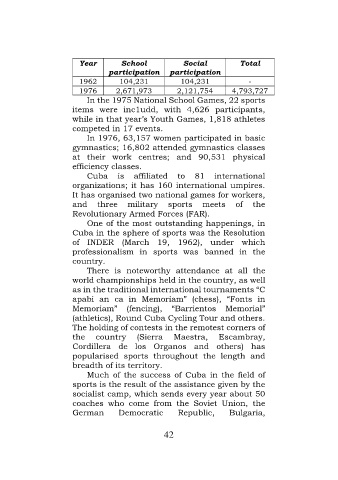
Year      School         Social         Total
                            participation   participation
                     1962      104,231        104,231          -
                     1976     2,671,973      2,121,754     4,793,727
                       In the 1975 National School Games, 22 sports
                   items  were  inc1udd,  with  4,626  participants,
                   while in that year’s Youth Games, 1,818 athletes
                   competed in 17 events.
                       In 1976, 63,157 women participated in basic
                   gymnastics; 16,802 attended gymnastics classes
                   at  their  work  centres;  and  90,531  physical
                   efficiency classes.
                       Cuba  is  affiliated  to  81  international
                   organizations; it has 160 international umpires.
                   It has organised two national games for workers,
                   and  three  military  sports  meets  of  the
                   Revolutionary Armed Forces (FAR).
                       One of the most outstanding happenings, in
                   Cuba in the sphere of sports was the Resolution
                   of  INDER  (March  19,  1962),  under  which
                   professionalism  in  sports  was  banned  in  the
                   country.
                       There  is  noteworthy  attendance  at  all  the
                   world championships held in the country, as well
                   as in the traditional international tournaments “C
                   apabi  an  ca  in  Memoriam”  (chess),  “Fonts  in
                   Memoriam”  (fencing),  “Barrientos  Memorial”
                   (athletics), Round Cuba Cycling Tour and others.
                   The holding of contests in the remotest corners of
                   the   country   (Sierra   Maestra,   Escambray,
                   Cordillera  de  los  Organos  and  others)  has
                   popularised  sports  throughout  the  length  and
                   breadth of its territory.
                       Much of the success of Cuba in the  field of
                   sports is the result of the assistance given by the
                   socialist camp, which sends every year about 50
                   coaches  who  come  from  the  Soviet  Union,  the
                   German     Democratic     Republic,    Bulgaria,

                                          42

