


Page 237 - REPOWER REFERENCE GUIDE (2020)
P. 237
Single Catalyst V8 Engines
                  IMPORTANT: The exhaust manifold and elbow, with catalyst, weigh in excess of 45 kg (100 lb). The use of a hoist is highly
                  recommended. If a hoist is not available, two people should be employed for manifold removal. It may be necessary to
                  remove the elbow and the catalyst to reduce the weight of the assembly to an amount that is safe to lift without the use of a
                  hoist.
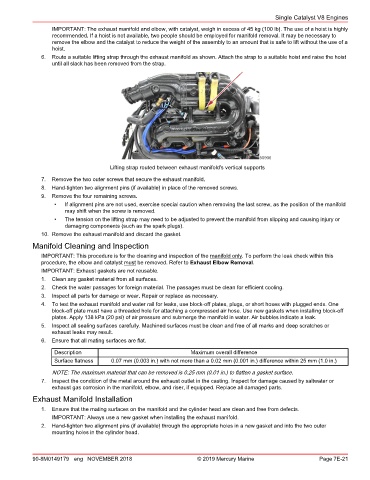
               6.  Route a suitable lifting strap through the exhaust manifold as shown. Attach the strap to a suitable hoist and raise the hoist
                  until all slack has been removed from the strap.


                                                                                       50906
                                     Lifting strap routed between exhaust manifold's vertical supports
               7.  Remove the two outer screws that secure the exhaust manifold.
               8.  Hand‑tighten two alignment pins (if available) in place of the removed screws.
               9.  Remove the four remaining screws.
                   •   If alignment pins are not used, exercise special caution when removing the last screw, as the position of the manifold
                       may shift when the screw is removed.
                   •   The tension on the lifting strap may need to be adjusted to prevent the manifold from slipping and causing injury or
                       damaging components (such as the spark plugs).
               10. Remove the exhaust manifold and discard the gasket.
            Manifold Cleaning and Inspection
               IMPORTANT: This procedure is for the cleaning and inspection of the manifold only. To perform the leak check within this
               procedure, the elbow and catalyst must be removed. Refer to Exhaust Elbow Removal.
               IMPORTANT: Exhaust gaskets are not reusable.
               1.  Clean any gasket material from all surfaces.
               2.  Check the water passages for foreign material. The passages must be clean for efficient cooling.
               3.  Inspect all parts for damage or wear. Repair or replace as necessary.
               4.  To test the exhaust manifold and water rail for leaks, use block‑off plates, plugs, or short hoses with plugged ends. One
                  block‑off plate must have a threaded hole for attaching a compressed air hose. Use new gaskets when installing block‑off
                  plates. Apply 138 kPa (20 psi) of air pressure and submerge the manifold in water. Air bubbles indicate a leak.
               5.  Inspect all sealing surfaces carefully. Machined surfaces must be clean and free of all marks and deep scratches or
                  exhaust leaks may result.
               6.  Ensure that all mating surfaces are flat.

                   Description                                  Maximum overall difference
                   Surface flatness   0.07 mm (0.003 in.) with not more than a 0.02 mm (0.001 in.) difference within 25 mm (1.0 in.)
                  NOTE: The maximum material that can be removed is 0.25 mm (0.01 in.) to flatten a gasket surface.
               7.  Inspect the condition of the metal around the exhaust outlet in the casting. Inspect for damage caused by saltwater or
                  exhaust gas corrosion in the manifold, elbow, and riser, if equipped. Replace all damaged parts.
            Exhaust Manifold Installation

               1.  Ensure that the mating surfaces on the manifold and the cylinder head are clean and free from defects.
                  IMPORTANT: Always use a new gasket when installing the exhaust manifold.
               2.  Hand‑tighten two alignment pins (if available) through the appropriate holes in a new gasket and into the two outer
                  mounting holes in the cylinder head.


            90-8M0149179 eng NOVEMBER 2018                        © 2019 Mercury Marine                    Page 7E-21

