


Page 275 - REPOWER REFERENCE GUIDE (2020)
P. 275
Critical Procedures

                Description                                                             Nm        lb‑in.      lb‑ft
                Idler pulley adjustment                                               9.5–11.5  84.1–101.8     –
            Checking
               Inspect the drive belt for proper tension and for the following:
               •  Excessive wear
               •  Cracks
                  NOTE: Minor, transverse cracks (across the belt width) may be acceptable. Longitudinal cracks (in the direction of belt
                  length) that join transverse cracks are NOT acceptable.
               •  Fraying
               •  Glazed surfaces
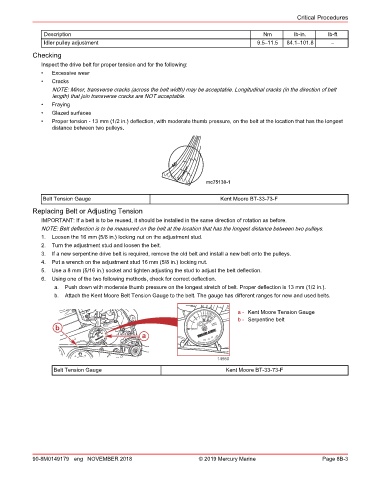
               •  Proper tension ‑ 13 mm (1/2 in.) deflection, with moderate thumb pressure, on the belt at the location that has the longest
                  distance between two pulleys.


                                                                     mc75130-1

               Belt Tension Gauge                                         Kent Moore BT‑33‑73‑F
            Replacing Belt or Adjusting Tension

               IMPORTANT: If a belt is to be reused, it should be installed in the same direction of rotation as before.
               NOTE: Belt deflection is to be measured on the belt at the location that has the longest distance between two pulleys.
               1.  Loosen the 16 mm (5/8 in.) locking nut on the adjustment stud.
               2.  Turn the adjustment stud and loosen the belt.
               3.  If a new serpentine drive belt is required, remove the old belt and install a new belt onto the pulleys.
               4.  Put a wrench on the adjustment stud 16 mm (5/8 in.) locking nut.
               5.  Use a 8 mm (5/16 in.) socket and tighten adjusting the stud to adjust the belt deflection.
               6.  Using one of the two following methods, check for correct deflection.
                   a.  Push down with moderate thumb pressure on the longest stretch of belt. Proper deflection is 13 mm (1/2 in.).
                   b.  Attach the Kent Moore Belt Tension Gauge to the belt. The gauge has different ranges for new and used belts.


                                                                                a - Kent Moore Tension Gauge
                                                                                b - Serpentine belt
                                                                      NEWTONE  2.83918
                   b                                              NEWTONE  COLOR GUIDE  PATENT
                                                                    for
                                                a


                                                                         14980
                   Belt Tension Gauge                                       Kent Moore BT‑33‑73‑F


            90-8M0149179 eng NOVEMBER 2018                         © 2019 Mercury Marine                    Page 8B-3

