


Page 115 - Science Class 6 Times Publication
P. 115
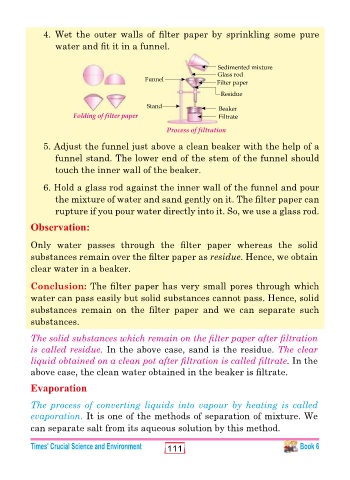
4. Wet the outer walls of lter paper by sprinkling some pure
water and t it in a funnel.
5. Adjust the funnel just above a clean beaker with the help of a
funnel stand. The lower end of the stem of the funnel should
touch the inner wall of the beaker.
6. Hold a glass rod against the inner wall of the funnel and pour
the mixture of water and sand gently on it. The lter paper can
rupture if you pour water directly into it. So, we use a glass rod.
Observation:
Only water passes through the lter paper whereas the solid
substances remain over the lter paper as residue. Hence, we obtain
clear water in a beaker.
Conclusion: The lter paper has very small pores through which
water can pass easily but solid substances cannot pass. Hence, solid
substances remain on the lter paper and we can separate such
substances.
The solid substances which remain on the lter paper after ltration
is called residue. In the above case, sand is the residue. The clear
liquid obtained on a clean pot after ltration is called ltrate. In the
above case, the clean water obtained in the beaker is ltrate.
Evaporation
The process of converting liquids into vapour by heating is called
evaporation. It is one of the methods of separation of mixture. We
can separate salt from its aqueous solution by this method.
Times' Crucial Science and Environment 111 Book 6

