


Page 116 - Science Class 6 Times Publication
P. 116
Activity 10.5
To separate salt from a solution of salt and water
Materials required
A solution of salt and water, porcelain basin, tripod stand, wire
gauge, burner, etc.
Procedure
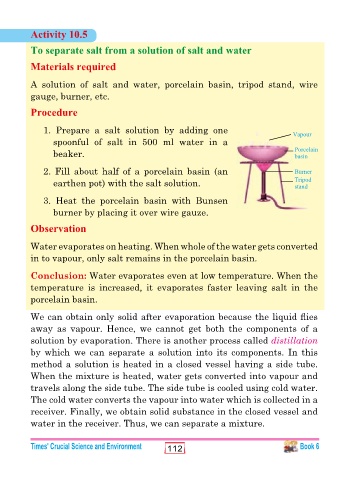
1. Prepare a salt solution by adding one Vapour
spoonful of salt in 500 ml water in a
beaker. Porcelain
basin
2. Fill about half of a porcelain basin (an Burner
earthen pot) with the salt solution. Tripod
stand
3. Heat the porcelain basin with Bunsen
burner by placing it over wire gauze.
Observation
Water evaporates on heating. When whole of the water gets converted
in to vapour, only salt remains in the porcelain basin.
Conclusion: Water evaporates even at low temperature. When the
temperature is increased, it evaporates faster leaving salt in the
porcelain basin.
We can obtain only solid after evaporation because the liquid ies
away as vapour. Hence, we cannot get both the components of a
solution by evaporation. There is another process called distillation
by which we can separate a solution into its components. In this
method a solution is heated in a closed vessel having a side tube.
When the mixture is heated, water gets converted into vapour and
travels along the side tube. The side tube is cooled using cold water.
The cold water converts the vapour into water which is collected in a
receiver. Finally, we obtain solid substance in the closed vessel and
water in the receiver. Thus, we can separate a mixture.
Times' Crucial Science and Environment 112 Book 6

