


Page 167 - Math Smart - 7
P. 167
CHAPTER 7.2


               equencyHBiies                                                                In this chapter

                                                                                         Pupils should be able to:
         for Grouped and                                                                 •     construct and use

                                                                                             frequency tables
          Ungrouped Data                                                                     to gather discrete
                                                                                             data, grouped where
                                                                                             appropriate in equal
                                                                                             class intervals
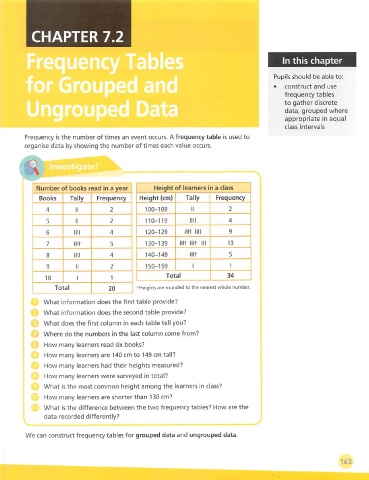
         Frequency is the number of times an event occurs. A frequency table is used to
         organise data by showing the number of times each value occurs.


             Number of books read in a year        Height of learners in a class
              Books     Tally   Frequency     Height (cm)    Tally     Frequency
                4        II         2           100-109        II          2
                5        II         2           110-119       nil          4

                6        nil        4           120-129     m Mil          9
                7        m          5           130-139    -mt m III      13
                8        nil        4           140-149       m            5

                9        n          2           150-159        1           1
                                                       Total              34
               10                    1
                   Total            20       ^Heights are rounded to the nearest whole number.
               What information does the first table provide?

               What information does the second table provide?
               What does the first column in each table tell you?
               Where do the numbers in the last column come from?
               How many learners read six books?
               How many learners are 140 cm to 149 cm tall?
               How many learners had their heights measured?

               How many learners were surveyed in total?
               What is the most common height among the learners in class?
               How many learners are shorter than 130 cm?
               What is the difference between the two frequency tables? How are the
               data recorded differently?

         We can construct frequency tables for grouped data and ungrouped data.

