


Page 168 - Math Smart - 7
P. 168
7.2.1  Frequency tables for ungrouped

                                            data


                                     Ungrouped data is data that is not organised into groups. In other words, the
                                     data are discrete. In an ungrouped data frequency table, data can be presented in
                                     a list.


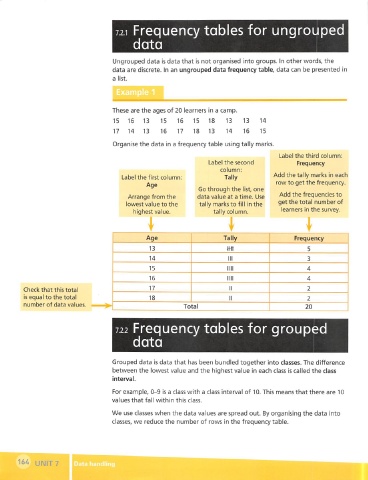
                                     These are the ages of 20 learners in a camp.
                                     15  16  13      15   16   15  18     13    13   14
                                     17  14  13      16   17   18  13     14    16   15

                                     Organise the data in a frequency table using tally marks.
                                                                                           Label the third column:
                                                                     Label the second            Frequency
                                                                        column:
                                                                                          Add the tally marks in each
                                        Label the first column:           Tally
                                                                                          row to get the frequency.
                                                Age
                                                                 Go through the list, one
                                                                                           Add the frequencies to
                                          Arrange from the       data value at a time. Use
                                          lowest value to the    tally marks to fill in the  get the total number of
                                            highest value.            tally column.         learners in the survey.


                                                Age                      Tally                  Frequency
                                                 13                       m                         5
                                                 14                        III                      3
                                                 15                        nil                      4
                                                 16                        nil                      4
         Check that this total                   17                        n                        2
         is equal to the total                   18                        n                        2
         number of data values.
                                                            Total                                   20

                                      7.2.2 Frequency tables for grouped


                                            data


                                     Grouped data is data that has been bundled together into classes. The difference
                                     between the lowest value and the highest value in each class is called the class
                                     interval.

                                     For example, 0-9 is a class with a class interval of 10. This means that there are 10
                                     values that fall within this class.
                                     We use classes when the data values are spread out. By organising the data into
                                     classes, we reduce the number of rows in the frequency table.


       164  UNIT7f       Data handling

