


Page 88 - Math Smart - 7
P. 88
In this chapter              4.2.4  Divide whole numbers and
      Pupils should be able to:
                                            decimals by 10,100 and 1000
      •     divide whole numbers
          and decimals by 10,100
          and 1000
                                             Investigate


                                           Jane is training for a cycling race. She needs to cycle 1832 km in
                                           10 weeks. How many kilometres should she cycle per week (assuming
                                           she cycles the same distance each week)?
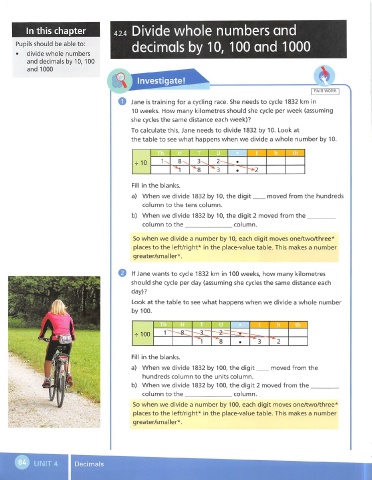
                                           To calculate this, Jane needs to divide 1832 by 10. Look at
                                           the table to see what happens when we divide a whole number by 10.


                                             v 10    1\   8\     3\    2~~~.  •
                                                              ^8     ^3      •

                                            Fill In the blanks.
                                            a)  When we divide 1832 by 10, the digit    moved from the hundreds
                                               column to the tens column,
                                            b) When we divide 1832 by 10, the digit 2 moved from the
                                               column to the                 column.

                                            So when we divide a number by 10, each digit moves one/two/three*
                                            places to the left/right* in the place-value table. This makes a number
                                            greater/smaller*.

                                            If Jane wants to cycle 1832 km in 100 weeks, how many kilometres
                                           should she cycle per day (assuming she cycles the same distance each
                                           day)?
                                            Look at the table to see what happens when we divide a whole number
                                            by 100.                                                          ^1


                                                o
                                                  o
                                                                                                                1
                                                                                                                3
                                                                                                                2
                                            Fill in the blanks,                                                 •  ""8
                                           a) When we divide 1832 by 100, the digit _    moved from the
                                               hundreds column to the units column.
                                            b) When we divide 1832 by 100, the digit 2 moved from the
                                               column to the                 column.
                                            So when we divide a number by 100, each digit moves one/two/three*
                                            places to the left/right* in the place-value table. This makes a number
                                            greater/smaller*.


                         Decimals

