


Page 85 - Math Smart - 7
P. 85
6
                X 100                        0        ^2^^3        ^
                                       2-^ —3^    •      6^
                                                                                          Nick and Jamie recorded the
                                                                                          distances they ran. Nick ran
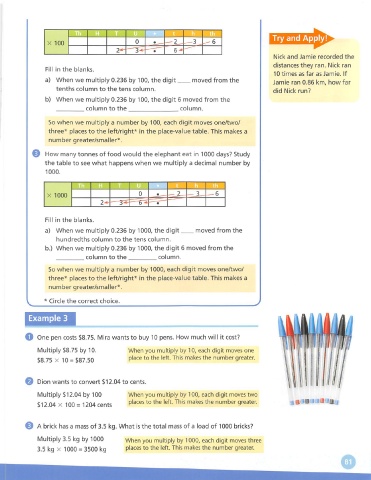
                Fill in the blanks.
                                                                                          10 times as far as Jamie. If
                a)  When we multiply 0.236 by ICQ, the digit   moved from the             Jamie ran 0.86 km, how far
                   tenths column to the tens column,
                                                                                          did Nick run?
                b) When we multiply 0.236 by 100, the digit 6 moved from the
                             column to the                 column.
                 So when we multiply a number by 100, each digit moves one/two/
                 three* places to the left/right* in the place-value table. This makes a
                 number greater/smaller*.

                How many tonnes of food would the elephant eat in 1000 days? Study
               the table to see what happens when we multiply a decimal number by
                1000.
                                     PlJ^  :
                X 1000                        0     •,        --iJ— -—6
                                 2*              •  •

                Fill in the blanks.
                a) When we multiply 0.236 by 1000, the digit _  moved from the
                   hundredths column to the tens column,
                b.) When we multiply 0.236 by 1000, the digit 6 moved from the
                             column to the          column.
                 So when we multiply a number by 1000, each digit moves one/two/
                three* places to the left/right* in the place-value table. This makes a
                 number greater/smaller*.

               * Circle the correct choice.

          Example 3


         O One pen costs $8.75. Mira wants to buy 10 pens. How much will it cost?

             Multiply $8.75 by 10.         When you multiply by 10, each digit moves one
                                           place to the left. This makes the number greater.
             $8.75 X 10 = $87.50


         O Dion wants to convert $12.04 to cents.

             Multiply $12.04 by 100        When you multiply by 100, each digit moves two
                                           places to the left. This makes the number greater.
             $12.04 X 100 = 1204 cents


         O A brick has a mass of 3.5 kg. What is the total mass of a load of 1000 bricks?

             Multiply 3.5 kg by 1000      When you multiply by 1000, each digit moves three
             3.5 kg X 1000 = 3500 kg      places to the left. This makes the number greater.
                                                                                                               o

