


Page 89 - Math Smart - 7
P. 89
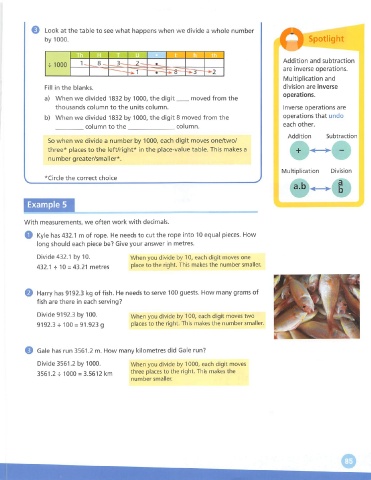
O Look at the table to see what happens when we divide a whole number
                                                                                          o
                by 1000.                                                                             Spotlight

                              1                          ^  _ m
                                                                                             Addition and subtraction
                           1_   8-^ _3--     2 —   •
                -rIOOO
                                                                                             are inverse operations.
                                           -Tl     i"—             -^2
                                                                                             Multiplication and
               Fill in the blanks.                                                           division are inverse
                                                                                             operations.
               a)  When we divided 1832 by 1000, the digit     moved from the
                   thousands column to the units column.                                     Inverse operations are
                b) When we divided 1832 by 1000, the digit 8 moved from the                  operations that undo
                             column to the                column.                            each other.
                                                                                              Addition     Subtraction
                So when we divide a number by 1000, each digit moves one/two/
                three* places to the left/right* in the place-value table. This makes a
                 number greater/smaller*.
                                                                                            Multiplication  Division
               *Circle the correct choice


          Example 5


         With measurements, we often work with decimals.
         O Kyle has 432.1 m of rope. He needs to cut the rope into 10 equal pieces. How
             long should each piece be? Give your answer in metres.

             Divide 432.1 by 10.           When you divide by 10, each digit moves one
                                           place to the right. This makes the number smaller.
             432.1 -r 10 = 43.21 metres


         O Harry has 9192.3 kg of fish. He needs to serve 100 guests. How many grams of
             fish are there in each serving?
             Divide 9192.3 by 100.         When you divide by 100, each digit moves two
             9192.3 ^ 100 = 91.923 g        places to the right. This makes the number smaller.


         O Gale has run 3561.2 m. How many kilometres did Gale run?
             Divide 3561.2 by 1000.        When you divide by 1000, each digit moves
                                           three places to the right. This makes the
             3561.2-j-1000 = 3.5612 km
                                           number smaller.


                                                                                                                ©

