


Page 84 - Math Smart - 7
P. 84
Check My
          Understanding


           O A bee colony produced 0.272 kg of honey. The beekeeper collected 91 g of the honey. How
               many kilograms of honey remains?
           © The mass of a baby elephant was 206.99 kg. After two years, her mass increased by 108.95 kg.
               Find the mass of the elephant after two years.
           © Leo had a piece of rope 35.15 m long. He cut the rope into two pieces. If the length of one piece
               of rope was 13.59 m, what was the length of the other piece of rope?
           O The length of each side of a regular polygon is 6.3 mm. Its perimeter is 31.5 mm.

               a) Find the number of sides the polygon has.
               b) Name the polygon.


                                      4.2.2  Multiplying whole numbers and

                                            decimals by 10, ICQ and 1000


                                              Investigate!
                                                                                                        PAIR WORK
                                            An elephant eats 0.236 tonne of food per day. How many tonnes will
                                            the elephant eat in 10 days? We need to multiply 0.236 by 10.
        Remember to fill in any
                                            Study the table to see what happens when we multiply a decimal
       spaces to the left of the
                                            number by 10.
        decimal point with zeros.
       This gives the correct
                                                                      itiv/ r  •  II
        place value to the rest of
                                             X 10                       0     •   ^2     /3     x6
       the digits.                                                      2     •      3^    6^

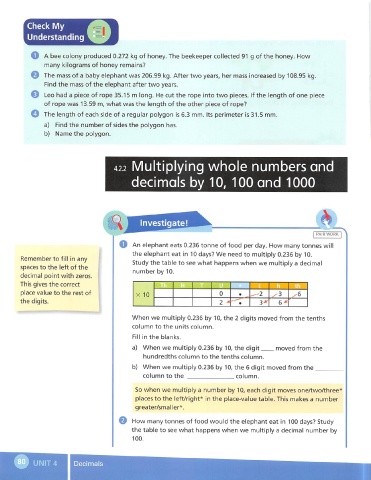
                                            When we multiply 0.236 by 10, the 2 digits moved from the tenths
                                            column to the units column.
                                            Fill in the blanks.
                                            a)  When we multiply 0.236 by 10, the digit   moved from the
                                               hundredths column to the tenths column.
                                            b) When we multiply 0.236 by 10, the 6 digit moved from the
                                               column to the                 column.
                                             So when we multiply a number by 10, each digit moves one/two/three*
                                             places to the left/right* in the place-value table. This makes a number
                                             greater/smaller*.

                                            How many tonnes of food would the elephant eat in 100 days? Study
                                            the table to see what happens when we multiply a decimal number by
                                            100.


            UNIT 4  I Decimals

