


Page 8 - Elementary Algebra Exercise Book I
P. 8
ELEMENTARY ALGEBRA EXERCISE BOOK I                                           reAl numBers


                                                                                          √
                                           √             √                        √         3      1
                                                                              2
                                                                                               2
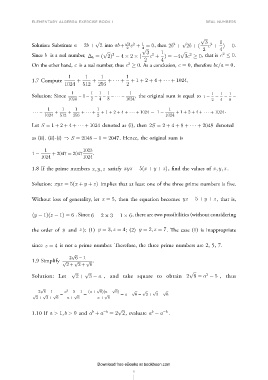
               Solution: Substitute a =2b +  2 into ab+   3 2   1  =0, then  2b +   2b +(     c + )= 0.
                                                           c +
                                                         2      4 √                        2       4
                                               √                  3      1       √
                                                                                                    2
                                                                     2
                                                   2
                                                                                     2
               Since  b  is a real number,  Δ b =( 2) − 4 × 2 × (   c + ) = −4 3c ≥ 0 , that is  c ≤ 0.
                                                                 2       4
               On the other hand, c is a real number, thus c ≥ 0. As a conclusion, c =0, therefore bc/a =0.
                                                          2
                               1       1      1          1
               1.7 Compute         +      +      + ··· +   +1 +2+4+ ··· + 1024.
                              1024    512    256         2
               Solution: Since   1  =1 −  1  −  1  −  1  − ··· −  1  , the original sum is equal to  1 −  1  −  1  −  1  − ··· −  1  +  1  +  1  + ··· +  1  + 1+ 2+ 4+ ··· + 1024 =

                               1024      2   4   8       1024                 1 1  1 1  1 1    2 1 1  4  8 1 1  1 1  1024  512 1 1  256  2
                                                                         1 1 − −  − −  − −  − ···  1 − −  + +  + +  + ··· + +  + 1+ 2+ 4+ ··· + 1024 = =
                                                                                                                          + 1+ 2+ 4+ ··· + 1024
                                                                                                                + ···
                                                                                        − ···
                                                                              2 2  4 4  8 8  1 −  1024  512  256       2 2
                                                                                               1024
                                                                                                      512
                                                                                                             256
                                                                                                +1+2+4 + ··· + 1024
    1   1   1         1      1    1         1                               1 1             1024
                                                                               +1+2+4 + ··· + 1024 .
                                                                      1
 1 −  −   −   − ··· −    +     +     + ··· +  + 1+ 2+ 4+ ··· + 1024 =  1 − −   +1+2+4        + ··· + 1024
                                                                          1024
    2   4   8        1024   512  256        2                             1024
  1
 1 −  +1+2+4 + ··· + 1024
 1024          Let  S = 1 +2+4+ ··· + 1024 denoted as (i), then  2S = 2 +4+8+ ··· + 2048 denoted
               as (ii). (ii)-(i)  ⇒ S = 2048 − 1 = 2047. Hence, the original sum is
                     1                1023
               1 −      + 2047 = 2047     .
                   1024               1024
               1.8 If the prime numbers  x,y,z  satisfy  xyz = 5(x + y + z), find the values of  x,y,z .
               Solution:  xyz = 5(x + y + z) implies that at least one of the three prime numbers is five.
               Without loss of generality, let  x =5, then the equation becomes  yz = 5+ y + z , that is,
               (y − 1)(z − 1) = 6 . Since  6 =2 × 3= 1 × 6 , there are two possibilities (without considering


               the order of  y  and  z ): (1)  y =3,z =4; (2)  y =2,z =7. The case (1) is inappropriate


               since  z =4 is not a prime number. Therefore, the three prime numbers are 2, 5, 7.

                                 √
                                2 6 − 1
               1.9 Simplify  √    √    √ .
                               2+   3+   6
                                 √     √                                             √
               Solution: Let       2+    3= a , and take square to obtain  2 6= a − 5 , thus
                                                                                             2

                   √                        √      √
                               2
                  2 6 − 1     a − 5 − 1  (a +  6)(a −  6)   √   √    √   √
                √   √    √ =      √   =        √       = a −  6=  2+  3 −  6.
                 2+   3+  6    a +  6       a +  6
                                                     √
                                                                    b
                                          b
               1.10 If  a> 1,b > 0 and  a + a  −b  =2 2, evaluate  a − a −b  .


                                            Download free eBooks at bookboon.com
                                                            8

