


Page 114 - Basic Principles of Textile Coloration
P. 114
CELLULOSE ACETATES 103

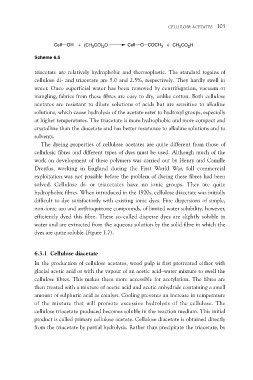
            Cell OH + (CH3CO)2O  Cell O COCH3 + CH3CO2H
Scheme 6.5

triacetate are relatively hydrophobic and thermoplastic. The standard regains of
cellulose di- and triacetate are 5.0 and 2.5%, respectively. They hardly swell in
water. Once superficial water has been removed by centrifugation, vacuum or
mangling, fabrics from these fibres are easy to dry, unlike cotton. Both cellulose
acetates are resistant to dilute solutions of acids but are sensitive to alkaline
solutions, which cause hydrolysis of the acetate ester to hydroxyl groups, especially
at higher temperatures. The triacetate is more hydrophobic and more compact and
crystalline than the diacetate and has better resistance to alkaline solutions and to
solvents.

   The dyeing properties of cellulose acetates are quite different from those of
cellulosic fibres and different types of dyes must be used. Although much of the
work on development of these polymers was carried out by Henry and Camille
Dreyfus, working in England during the First World War, full commercial
exploitation was not possible before the problem of dyeing these fibres had been
solved. Cellulose di- or triacetates have no ionic groups. They are quite
hydrophobic fibres. When introduced in the 1920s, cellulose diacetate was initially
difficult to dye satisfactorily with existing ionic dyes. Fine dispersions of simple,
non-ionic azo and anthraquinone compounds, of limited water solubility, however,
efficiently dyed this fibre. These so-called disperse dyes are slightly soluble in
water and are extracted from the aqueous solution by the solid fibre in which the
dyes are quite soluble (Figure 1.7).

6.3.1 Cellulose diacetate

In the production of cellulose acetates, wood pulp is first pretreated either with
glacial acetic acid or with the vapour of an acetic acid–water mixture to swell the
cellulose fibres. This makes them more accessible for acetylation. The fibres are
then treated with a mixture of acetic acid and acetic anhydride containing a small
amount of sulphuric acid as catalyst. Cooling prevents an increase in temperature
of the mixture that will promote excessive hydrolysis of the cellulose. The
cellulose triacetate produced becomes soluble in the reaction medium. This initial
product is called primary cellulose acetate. Cellulose diacetate is obtained directly
from the triacetate by partial hydrolysis. Rather than precipitate the triacetate, by

