


Page 112 - Basic Principles of Textile Coloration
P. 112
VISCOSE FIBRE 101

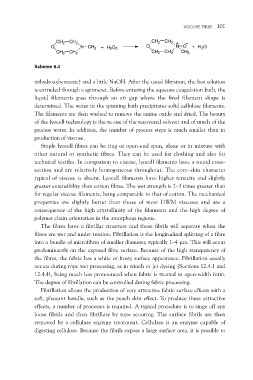
   CH2 CH2         CH2 CH2
O N CH3 + H2O2  O N O + H2O

   CH2 CH2         CH2 CH2 CH3

Scheme 6.4

trihydroxybenzoate) and a little NaOH. After the usual filtration, the hot solution
is extruded through a spinneret. Before entering the aqueous coagulation bath, the
liquid filaments pass through an air gap where the final filament shape is
determined. The water in the spinning bath precipitates solid cellulose filaments.
The filaments are then washed to remove the amine oxide and dried. The beauty
of the lyocell technology is the re-use of the recovered solvent and of much of the
process water. In addition, the number of process steps is much smaller than in
production of viscose.

   Staple lyocell fibres can be ring or open-end spun, alone or in mixture with
other natural or synthetic fibres. They can be used for clothing and also for
technical textiles. In comparison to viscose, lyocell filaments have a round cross-
section and are relatively homogeneous throughout. The core–skin character
typical of viscose is absent. Lyocell filaments have higher tenacity and slightly
greater extensibility than cotton fibres. The wet strength is 2–3 times greater than
for regular viscose filaments, being comparable to that of cotton. The mechanical
properties are slightly better than those of most HWM viscoses and are a
consequence of the high crystallinity of the filaments and the high degree of
polymer chain orientation in the amorphous regions.

   The fibres have a fibrillar structure and these fibrils will separate when the
fibres are wet and under tension. Fibrillation is the longitudinal splitting of a fibre
into a bundle of microfibres of smaller diameter, typically 1–4 mm. This will occur
predominantly on the exposed fibre surface. Because of the high transparency of
the fibres, the fabric has a white or frosty surface appearance. Fibrillation usually
occurs during rope wet processing, as in winch or jet dyeing (Sections 12.4.1 and
12.4.4), being much less pronounced when fabric is treated in open-width form.
The degree of fibrillation can be controlled during fabric processing.

   Fibrillation allows the production of very attractive fabric surface effects with a
soft, pleasant handle, such as the peach skin effect. To produce these attractive
effects, a number of processes is required. A typical procedure is to singe off any
loose fibrils and then fibrillate by rope scouring. The surface fibrils are then
removed by a cellulase enzyme treatment. Cellulase is an enzyme capable of
digesting cellulose. Because the fibrils expose a large surface area, it is possible to

