


Page 109 - Basic Principles of Textile Coloration
P. 109
98 ARTIFICIALLY MADE FIBRES BASED ON CELLULOSE

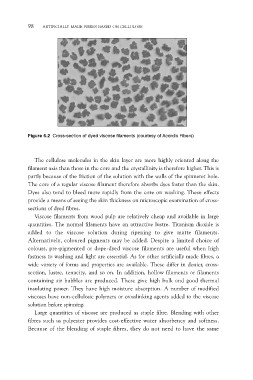
Figure 6.2 Cross-section of dyed viscose filaments (courtesy of Acordis Fibers)

   The cellulose molecules in the skin layer are more highly oriented along the
filament axis than those in the core and the crystallinity is therefore higher. This is
partly because of the friction of the solution with the walls of the spinneret hole.
The core of a regular viscose filament therefore absorbs dyes faster than the skin.
Dyes also tend to bleed more rapidly from the core on washing. These effects
provide a means of seeing the skin thickness on microscopic examination of cross-
sections of dyed fibres.

   Viscose filaments from wood pulp are relatively cheap and available in large
quantities. The normal filaments have an attractive lustre. Titanium dioxide is
added to the viscose solution during ripening to give matte filaments.
Alternatively, coloured pigments may be added. Despite a limited choice of
colours, pre-pigmented or dope-dyed viscose filaments are useful when high
fastness to washing and light are essential. As for other artificially made fibres, a
wide variety of forms and properties are available. These differ in denier, cross-
section, lustre, tenacity, and so on. In addition, hollow filaments or filaments
containing air bubbles are produced. These give high bulk and good thermal
insulating power. They have high moisture absorption. A number of modified
viscoses have non-cellulosic polymers or crosslinking agents added to the viscose
solution before spinning.

   Large quantities of viscose are produced as staple fibre. Blending with other
fibres such as polyester provides cost-effective water absorbency and softness.
Because of the blending of staple fibres, they do not need to have the same

