


Page 164 - Basic Principles of Textile Coloration
P. 164
IMPURITIES IN TEXTILE FIBRES 153

9.1 IMPURITIES IN TEXTILE FIBRES

At any stage during textile manufacture, from loose fibre to grey fabric, fibres may
contain a variety of hydrophobic chemicals that interfere with uniform wetting.
These impurities may be of natural origin, such as fats and waxes, or synthetic
chemicals deliberately applied to the fibres to facilitate processes such as carding,
spinning or knitting.

   Natural fats and oils are esters of glycerol (1,2,3-propanetriol) and high
molecular weight carboxylic acids called fatty acids. Since glycerol has three
hydroxyl groups, and each can be esterified, its esters are called triglycerides. The
fatty acids usually have an unbranched chain of up to about 20 carbon atoms with
a carboxylic acid group on the end carbon atom. In saturated fatty acids the
carbon atoms (other than that of the terminal carboxylic acid group) form only
single bonds, either to other carbon atoms or to hydrogen atoms, in an
unbranched chain. A typical example is stearic acid, CH3(CH2)16CO2H
(octadecanoic acid). The triglycerides of saturated fatty acids are usually solids at
room temperature.

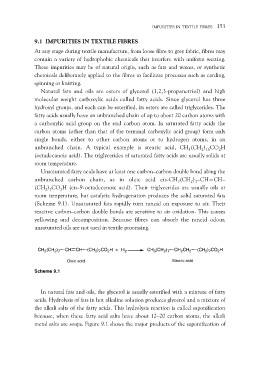
   Unsaturated fatty acids have at least one carbon–carbon double bond along the
unbranched carbon chain, as in oleic acid cis-CH3(CH2)7–CH=CH–
(CH2)7CO2H (cis-9-octadecenoic acid). Their triglycerides are usually oils at
room temperature, but catalytic hydrogenation produces the solid saturated fats
(Scheme 9.1). Unsaturated fats rapidly turn rancid on exposure to air. Their
reactive carbon–carbon double bonds are sensitive to air oxidation. This causes
yellowing and decomposition. Because fibres can absorb the rancid odour,
unsaturated oils are not used in textile processing.

  CH3(CH2)7 CH CH (CH2)7CO2H + H2   CH3(CH2)7 CH2CH2 (CH2)7CO2H
                        Oleic acid                    Stearic acid

Scheme 9.1

   In natural fats and oils, the glycerol is usually esterified with a mixture of fatty
acids. Hydrolysis of fats in hot alkaline solution produces glycerol and a mixture of
the alkali salts of the fatty acids. This hydrolysis reaction is called saponification
because, when these fatty acid salts have about 12–20 carbon atoms, the alkali
metal salts are soaps. Figure 9.1 shows the major products of the saponification of

