


Page 165 - Basic Principles of Textile Coloration
P. 165
154 AUXILIARY CHEMICALS FOR WET PROCESSING AND DYEING

CH2 O CO R′                 CH2 OH
CH O CO R′′ saponification  CH OH + 3R CO2H
CH2 O CO R′′′ OH H2O        CH2 OH

   Triglyceride              Glycerol

CH3(CH2)14CO2H                                       Palmitic acid (mutton tallow)

CH3(CH2)16CO2H                                       Stearic acid (mutton tallow)

CH3(CH2)7 CH CH (CH2)7CO2H                           Oleic acid (olive oil)

CH3(CH2)5 CH CH2 CH CH (CH2)7CO2H Ricinoleic acid (castor oil)
                 OH

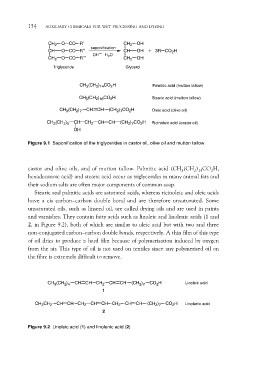
Figure 9.1 Saponification of the triglycerides in castor oil, olive oil and mutton tallow

castor and olive oils, and of mutton tallow. Palmitic acid (CH3(CH2)14CO2H,
hexadecanoic acid) and stearic acid occur as triglycerides in many animal fats and
their sodium salts are often major components of common soap.

   Stearic and palmitic acids are saturated acids, whereas ricinoleic and oleic acids
have a cis carbon–carbon double bond and are therefore unsaturated. Some
unsaturated oils, such as linseed oil, are called drying oils and are used in paints
and varnishes. They contain fatty acids such as linoleic and linolenic acids (1 and
2, in Figure 9.2), both of which are similar to oleic acid but with two and three
non-conjugated carbon–carbon double bonds, respectively. A thin film of this type
of oil dries to produce a hard film because of polymerisation induced by oxygen
from the air. This type of oil is not used on textiles since any polymerised oil on
the fibre is extremely difficult to remove.

CH3(CH2)4 CH CH CH2 CH CH (CH2)7 CO2H                  Linoleic acid
                                    1

CH3CH2 CH CH CH2 CH CH CH2 CH CH (CH2)7 CO2H           Linolenic acid
                                            2

Figure 9.2 Linoleic acid (1) and linolenic acid (2)

