


Page 166 - Basic Principles of Textile Coloration
P. 166
SURFACE ACTIVITY OF DETERGENTS 155

   Waxes are often either high molecular weight alcohols (fatty alcohols) or their
esters with fatty acids. They are solids with high melting points and very low water
solubility. The fatty alcohols do not hydrolyse in alkaline solution and their esters
are much more resistant to hydrolysis than triglycerides. Other types of waxes are
mixtures of high molecular weight inert alcanes such as paraffin wax.

   Both fats and waxes occur as contaminants in textiles, particularly those of
natural origin. They are often added to warp size as lubricants. In addition, a
material will also usually contain natural or synthetic oils added to lubricate the
fibres to assist mechanical processes such as carding or knitting. Fats, oils and
waxes are hydrophobic and water-insoluble. Their presence on the surface of a
fibre greatly hinders wetting so they must be removed by scouring. This involves
treatment of the goods with an aqueous solution of a detergent, sometimes under
alkaline conditions, or with an organic solvent. An alkaline solution of a detergent
such as soap can remove fats and oils by saponification of glycerides, or by
emulsification, whereas a non-polar organic solvent such as perchloroethylene
(tetrachloroethene) dissolves these hydrophobic impurities. It is not uncommon to
scour with an aqueous solution of detergent containing a small quantity of an
appropriate organic solvent in emulsion, in which case saponification,
emulsification and dissolution can occur simultaneously. We will now examine
exactly how a detergent acts in scouring.

9.2 SURFACE ACTIVITY OF DETERGENTS

Simple soaps are the sodium salts of fatty acids with 12–20 carbon atoms, typified
by stearic and palmitic acids. They are obtained by saponification of animal fats
using aqueous NaOH and precipitated by addition of NaCl, the glycerol remaining
in solution. The potassium salts of fatty acids, obtained by saponification using
KOH, are more soluble than sodium soaps. Because they are difficult to separate,
they are often available as soft soaps, thick concentrated aqueous solutions still
containing glycerol. Natural sodium soaps have limited solubility in cold water.
They are more soluble in hot water but redeposit on cooling, forming a gel. Since a
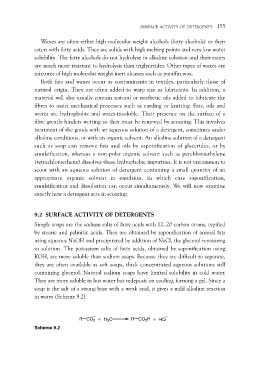
soap is the salt of a strong base with a weak acid, it gives a mild alkaline reaction
in water (Scheme 9.2).

            R CO2 + H2O  R CO2H + HO

Scheme 9.2

