


Page 167 - Basic Principles of Textile Coloration
P. 167
156 AUXILIARY CHEMICALS FOR WET PROCESSING AND DYEING

   The major disadvantages of natural soaps are that they precipitate in acidic
solution at below pH 5, forming the insoluble free fatty acid, and also in hard
water forming the calcium and magnesium salts (Section 8.1). They also readily
precipitate in the presence of excess sodium ions. Although modern synthetic
surfactants have almost completely replaced natural soaps in textile wet
processing, a simple soap solution is a suitable point to begin a discussion of
surface activity.

9.2.1 Basic thermodynamics

Before discussing the surface activity and aggregation of soap molecules, a brief
introduction to thermodynamics is appropriate. All processes are governed by the
laws of thermodynamics. The key thermodynamic equation for predicting whether
a process is probable or not is:

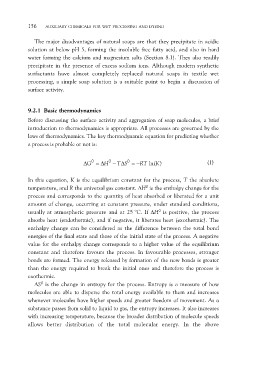
DG0 = DH0 - TDS0 = -RT ln(K )  (1)

In this equation, K is the equilibrium constant for the process, T the absolute
temperature, and R the universal gas constant. DH0 is the enthalpy change for the
process and corresponds to the quantity of heat absorbed or liberated for a unit
amount of change, occurring at constant pressure, under standard conditions,
usually at atmospheric pressure and at 25 °C. If DH0 is positive, the process
absorbs heat (endothermic), and if negative, it liberates heat (exothermic). The
enthalpy change can be considered as the difference between the total bond
energies of the final state and those of the initial state of the process. A negative
value for the enthalpy change corresponds to a higher value of the equilibrium
constant and therefore favours the process. In favourable processes, stronger
bonds are formed. The energy released by formation of the new bonds is greater
than the energy required to break the initial ones and therefore the process is
exothermic.

   DS0 is the change in entropy for the process. Entropy is a measure of how
molecules are able to disperse the total energy available to them and increases
whenever molecules have higher speeds and greater freedom of movement. As a
substance passes from solid to liquid to gas, the entropy increases. It also increases
with increasing temperature, because the broader distribution of molecule speeds
allows better distribution of the total molecular energy. In the above

