


Page 204 - Basic Principles of Textile Coloration
P. 204
CONTINUOUS DYEING 193
The greater the applied pressure at the nip, the smaller the amount of dye
solution retained by the fabric. The latter is called the wet pick-up, the weight of
dye solution retained per 100 g of dry fabric. It should be high enough that there
is sufficient solution to adequately wet the fibres and yarns and allow the dye to
uniformly reach the fibre surfaces, but not so high that there is excessive migration
on drying (Section 10.5.3). The wet pick-up cannot be decreased below a certain
limit, no matter how high the nip pressure because it is not possible to squeeze out
the water absorbed by the fibres and that adhering to the fibre surfaces. When the
nip pressure decreases, after passage of the fabric, some of the expressed water is
always re-absorbed. The minimum wet pick-up is usually around 55–60% for
cotton/polyester materials, 60–70% for cotton, and higher for fabrics of the more
absorbent viscose.
Under ideal conditions, the dyes will have no substantivity for the fibres being
treated and the amount of dye in the fabric can be calculated from the liquor
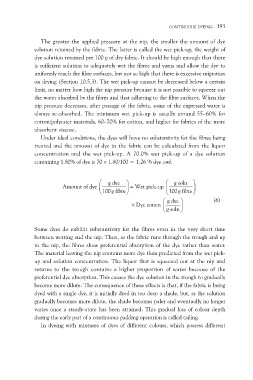
concentration and the wet pick-up. A 70.0% wet pick-up of a dye solution
containing 1.80% of dye is 70 ´ 1.80/100 = 1.26 % dye owf.
Amount of dye Ë g dye Û = Wet pick-up Ë g soln Û
ÍÌ 100 g fibreÜÝ ÌÍ 100 g fibreÜÝ
Dye concn Ë g dye Û (6)
ÌÍ g soln ÜÝ
Some dyes do exhibit substantivity for the fibres even in the very short time
between wetting and the nip. Then, as the fabric runs through the trough and up
to the nip, the fibres show preferential absorption of the dye rather than water.
The material leaving the nip contains more dye than predicted from the wet pick-
up and solution concentration. The liquor that is squeezed out at the nip and
returns to the trough contains a higher proportion of water because of the
preferential dye absorption. This causes the dye solution in the trough to gradually
become more dilute. The consequence of these effects is that, if the fabric is being
dyed with a single dye, it is initially dyed in too deep a shade, but, as the solution
gradually becomes more dilute, the shade becomes paler and eventually no longer
varies once a steady-state has been attained. This gradual loss of colour depth
during the early part of a continuous padding operation is called tailing.
In dyeing with mixtures of dyes of different colours, which possess different

