


Page 203 - Basic Principles of Textile Coloration
P. 203
192 AN INTRODUCTION TO DYES AND DYEING

other procedures are also used, particularly for carpets. These include flowing or
spraying dye liquor onto the moving carpet, or its application as foam.

   The objective of padding is to impregnate the fabric with a solution or
dispersion of dyes and chemicals as uniformly as possibly, both lengthways and
side-to-side. To produce long lengths of fabric, all with the same colour, requires
the maintenance of constant padding conditions over long periods of time. A pad
or padder consists of a narrow trough, which is slightly wider than the fabric, and a
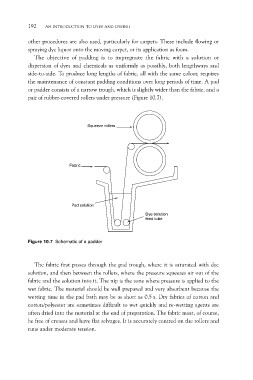
pair of rubber-covered rollers under pressure (Figure 10.7).

                                             Squeeze rollers

Fabric

Pad solution

                                   Dye solution
                                   feed tube

Figure 10.7 Schematic of a padder

   The fabric first passes through the pad trough, where it is saturated with dye
solution, and then between the rollers, where the pressure squeezes air out of the
fabric and the solution into it. The nip is the zone where pressure is applied to the
wet fabric. The material should be well prepared and very absorbent because the
wetting time in the pad bath may be as short as 0.5 s. Dry fabrics of cotton and
cotton/polyester are sometimes difficult to wet quickly and re-wetting agents are
often dried into the material at the end of preparation. The fabric must, of course,
be free of creases and have flat selvages. It is accurately centred on the rollers and
runs under moderate tension.

