


Page 238 - Basic Principles of Textile Coloration
P. 238
MACHINES FOR DYEING FABRIC 227

roller may also have a lower temperature unless the roller is wrapped to minimise
heat transfer to the metal. It is usual to add only half the dye solution at the
beginning of the first end, the rest being added before the second. Before dyeing
begins, an end cloth may be passed back and forth through the heated bath to
heat up the draw roller. Listing can arise from non-uniform temperature across the
width of the fabric, or from non-uniform pressure that squeezes the retained dye
liquor across the fabric width between the layers. After dyeing, the roll of fabric
slowly turns to avoid drainage of dye liquor into the lower layers of fabric. Moiré
effects or water marks may arise on some acetate and nylon fabrics because of
pressure flattening the structure of the rolled fabric. Larger diameter rollers, and a
soft end cloth, avoid this.

12.4.3 Beam dyeing machines

In principle, beam dyeing is similar to package dyeing but with a single large
package. As mentioned above, beams of warp yarns can be dyed by circulating dye
liquor through the bed of yarns laid down on a perforated roller. Beam dyeing of
fabric involves winding it onto a perforated beam and pumping dye liquor through
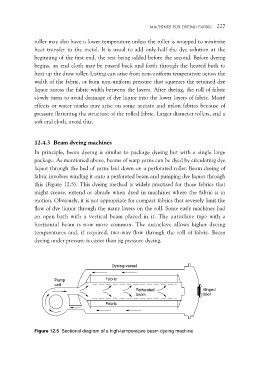
this (Figure 12.5). This dyeing method is widely practised for those fabrics that
might crease, extend or abrade when dyed in machines where the fabric is in
motion. Obviously, it is not appropriate for compact fabrics that severely limit the
flow of dye liquor through the many layers on the roll. Some early machines had
an open bath with a vertical beam placed in it. The autoclave type with a
horizontal beam is now more common. The autoclave allows higher dyeing
temperatures and, if required, two-way flow through the roll of fabric. Beam
dyeing under pressure is easier than jig pressure dyeing.

      Dyeing vessel

Pump  Fabric
unit  Fabric

              Perforated                                                 Hinged
              beam                                                       door

Figure 12.5 Sectional diagram of a high-temperature beam dyeing machine

