


Page 316 - Basic Principles of Textile Coloration
P. 316
THE ORIGINS OF SUBSTANTIVITY FOR CELLULOSE 305

that the dye adsorbs on specific fibre sites. This dichotomy of behaviour is typical
of the poor understanding of dyeing cellulose fibres.

   Direct dyes invariably have extended, conjugated, coplanar molecules, with
widely spaced hydrogen bonding groups and some sulphonate groups to provide
solubility in water. The greater the number of sulphonate groups in the dye
molecule, the higher the water solubility but the lower the fastness to wet
treatments, and the lower the dye substantivity. Molecular coplanarity is, however,
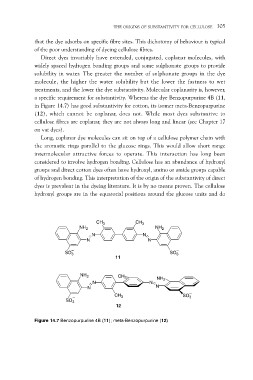
a specific requirement for substantivity. Whereas the dye Benzopurpurine 4B (11,
in Figure 14.7) has good substantivity for cotton, its isomer meta-Benzopurpurine
(12), which cannot be coplanar, does not. While most dyes substantive to
cellulose fibres are coplanar, they are not always long and linear (see Chapter 17
on vat dyes).

   Long, coplanar dye molecules can sit on top of a cellulose polymer chain with
the aromatic rings parallel to the glucose rings. This would allow short range
intermolecular attractive forces to operate. This interaction has long been
considered to involve hydrogen bonding. Cellulose has an abundance of hydroxyl
groups and direct cotton dyes often have hydroxyl, amino or amide groups capable
of hydrogen bonding. This interpretation of the origin of the substantivity of direct
dyes is prevalent in the dyeing literature. It is by no means proven. The cellulose
hydroxyl groups are in the equatorial positions around the glucose units and do

     NH2            CH3         CH3        NH2

        N                           N
     N                                  N

SO3                      11                                   SO3

         NH2               CH3      NH2
                 N              N
                         CH3
              N          12         N

SO3                                                                SO3

Figure 14.7 Benzopurpurine 4B (11); meta-Benzopurpurine (12)

