


Page 318 - Basic Principles of Textile Coloration
P. 318
307

CHAPTER 15

Disperse dyes

15.1 INTRODUCTION TO DISPERSE DYES

Cotton can be dyed with anionic direct, sulphur, vat, reactive and azoic dyes.
These types of dyes, however, are of little use for the dyeing of synthetic fibres.
Disperse dyes, on the other hand, are non-ionic. They dye all the synthetic and
cellulose acetate fibres using a direct dyeing technique. Only the dyeing
temperature varies from one fibre to another. They are thus one of the major
classes of dyestuff. The development of disperse dyes for dyeing secondary
cellulose acetate fibres in the early 1920s was a major technological breakthrough.
Their major use today is for the coloration of polyesters, the most important group
of synthetic fibres.

   What is a disperse dye? These non-ionic dyes are relatively insoluble in water at
room temperature and have only limited solubility at higher temperatures. They
do, however, possess substantivity for hydrophobic fibres such as nylon and
polyester, in which they are quite soluble. As their name implies, these dyes are
present in the dyebath as a fine aqueous suspension in the presence of a dispersing
agent. The water dissolves a small amount of the dye in monomolecular form. The
hydrophobic fibres then absorb the dye from the solution. Because these dyes are
non-ionic organic compounds of relatively low molecular weight, many sublime on
heating and dyeing by absorption of the dye vapour is also possible.

   When cellulose diacetate fibres first appeared in 1921, few of the available ionic
dyes were able to successfully colour them. Secondary acetate fibres absorb little
water, do not swell and have only small pores. In addition, their surface potential is
much more negative than that of cotton and therefore they repel anionic dyes.
Although cellulose diacetate fibres will absorb some cationic dyes, and a few acid
dyes, there is little or no penetration of the dye unless the fibre is pre-swollen. The
dyeings produced using ionic dyes also have poor fastness properties.

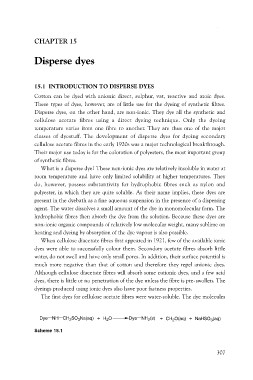
   The first dyes for cellulose acetate fibres were water-soluble. The dye molecules

   Dye NH CH2SO3Na(aq) + H2O  Dye NH2(s) + CH2O(aq) + NaHSO3(aq)
Scheme 15.1

                              307

