


Page 322 - Basic Principles of Textile Coloration
P. 322
DISPERSE DYE DISPERSIONS 311

CH3(CH2)5CH CH2 CH CH (CH2)7 CO2R
              OSO3Na
                            1

CH3(CH2)7CH CH (CH2)7 CONH  SO3
                               OCH3

2

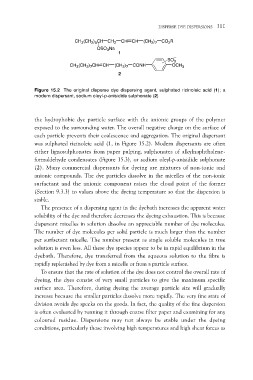
Figure 15.2 The original disperse dye dispersing agent, sulphated ricinoleic acid (1); a
modern dispersant, sodium oleyl-p-anisidide sulphonate (2)

the hydrophobic dye particle surface with the anionic groups of the polymer
exposed to the surrounding water. The overall negative charge on the surface of
each particle prevents their coalescence and aggregation. The original dispersant
was sulphated ricinoleic acid (1, in Figure 15.2). Modern dispersants are often
either lignosulphonates from paper pulping, sulphonates of alkylnaphthalene-
formaldehyde condensates (Figure 15.3), or sodium oleyl-p-anisidide sulphonate
(2). Many commercial dispersants for dyeing are mixtures of non-ionic and
anionic compounds. The dye particles dissolve in the micelles of the non-ionic
surfactant and the anionic component raises the cloud point of the former
(Section 9.3.3) to values above the dyeing temperature so that the dispersion is
stable.

   The presence of a dispersing agent in the dyebath increases the apparent water
solubility of the dye and therefore decreases the dyeing exhaustion. This is because
dispersant micelles in solution dissolve an appreciable number of dye molecules.
The number of dye molecules per solid particle is much larger than the number
per surfactant micelle. The number present as single soluble molecules in true
solution is even less. All these dye species appear to be in rapid equilibrium in the
dyebath. Therefore, dye transferred from the aqueous solution to the fibre is
rapidly replenished by dye from a micelle or from a particle surface.

   To ensure that the rate of solution of the dye does not control the overall rate of
dyeing, the dyes consist of very small particles to give the maximum specific
surface area. Therefore, during dyeing the average particle size will gradually
increase because the smaller particles dissolve more rapidly. The very fine state of
division avoids dye specks on the goods. In fact, the quality of the fine dispersion
is often evaluated by running it through coarse filter paper and examining for any
coloured residue. Dispersions may not always be stable under the dyeing
conditions, particularly those involving high temperatures and high shear forces as

