


Page 367 - Basic Principles of Textile Coloration
P. 367
356 REACTIVE DYES

products for dyeing wool with reactive dyes accelerate dyeing. The anionic dye
complexes with the cationic site in the auxiliary product but the remaining anionic
site provides substantivity for the wool surface. The bulky dye–auxiliary complex
exhausts well onto the fibre surface at relatively low temperature, better than the
dye alone, but cannot penetrate into the fibres. The complex breaks down as the
dyeing temperature increases so that the smaller liberated dye molecules can then
absorb into the wool. The use of such products avoids unlevel, skittery dyeings and
provides better compatibility of dye mixtures.

   Deeply dyed goods must be aftertreated to remove unfixed dye so as to give the
best wet fastness. This is particularly important to ensure that there is no staining
of adjacent undyed material during washing. After dyeing, the material can be
washed at 80 °C for about 15 min using a dilute ammonia solution at pH 8.0–8.5,
and then rinsed in water with a little acetic acid. To avoid any alkali damage to the
wool, washing can be done with hexamine (hexamethylenetetramine from
formaldehyde and ammonia) at pH 6.5, or with sodium bicarbonate. Certain
proprietary chemicals can be added to the dyebath on completion of dyeing and
their hydrolysis increases the bath pH to around 7. For example, hydrolysis of
sodium trichloroacetate gives chloroform, carbon dioxide, both of which are
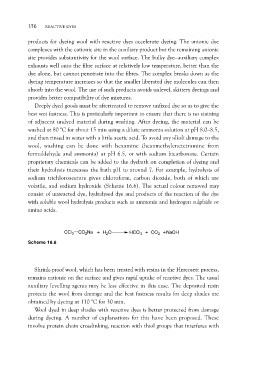
volatile, and sodium hydroxide (Scheme 16.6). The actual colour removed may
consist of unreacted dye, hydrolysed dye and products of the reaction of the dye
with soluble wool hydrolysis products such as ammonia and hydrogen sulphide or
amino acids.

             CCl3 CO2Na + H2O  HCCl3 + CO2 +NaOH

Scheme 16.6

   Shrink-proof wool, which has been treated with resins in the Hercosett process,
remains cationic on the surface and gives rapid uptake of reactive dyes. The usual
auxiliary levelling agents may be less effective in this case. The deposited resin
protects the wool from damage and the best fastness results for deep shades are
obtained by dyeing at 110 °C for 30 min.

   Wool dyed in deep shades with reactive dyes is better protected from damage
during dyeing. A number of explanations for this have been proposed. These
involve protein chain crosslinking, reaction with thiol groups that interferes with

