


Page 371 - Basic Principles of Textile Coloration
P. 371
360 VAT DYES

                O   O
              CONH          NH O

                                    O NH         NHCO
                                              O  O

                                                     CI Vat Brown 8

              OO

                    OO       CI Vat Green 1
                    CH3 CH3

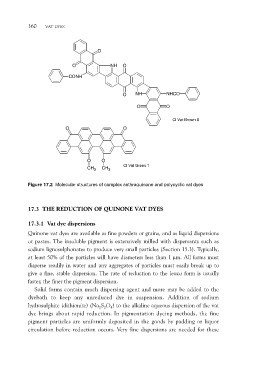
Figure 17.2 Molecular structures of complex anthraquinone and polycyclic vat dyes

17.3 THE REDUCTION OF QUINONE VAT DYES

17.3.1 Vat dye dispersions

Quinone vat dyes are available as fine powders or grains, and as liquid dispersions
or pastes. The insoluble pigment is extensively milled with dispersants such as
sodium lignosulphonates to produce very small particles (Section 15.3). Typically,
at least 50% of the particles will have diameters less than 1 mm. All forms must
disperse readily in water and any aggregates of particles must easily break up to
give a fine, stable dispersion. The rate of reduction to the leuco form is usually
faster, the finer the pigment dispersion.

   Solid forms contain much dispersing agent and more may be added to the
dyebath to keep any unreduced dye in suspension. Addition of sodium
hydrosulphite (dithionite) (Na2S2O4) to the alkaline aqueous dispersion of the vat
dye brings about rapid reduction. In pigmentation dyeing methods, the fine
pigment particles are uniformly deposited in the goods by padding or liquor
circulation before reduction occurs. Very fine dispersions are needed for these

