


Page 394 - Basic Principles of Textile Coloration
P. 394
BATCH DYEING PROCEDURES WITH SULPHUR DYES 383

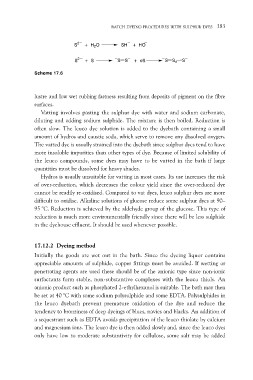
             S2 + H2O    SH + HO  S Sn S
             S2 + S    S S + nS

Scheme 17.6

lustre and low wet rubbing fastness resulting from deposits of pigment on the fibre
surfaces.

   Vatting involves pasting the sulphur dye with water and sodium carbonate,
diluting and adding sodium sulphide. The mixture is then boiled. Reduction is
often slow. The leuco dye solution is added to the dyebath containing a small
amount of hydros and caustic soda, which serve to remove any dissolved oxygen.
The vatted dye is usually strained into the dyebath since sulphur dyes tend to have
more insoluble impurities than other types of dye. Because of limited solubility of
the leuco compounds, some dyes may have to be vatted in the bath if large
quantities must be dissolved for heavy shades.

   Hydros is usually unsuitable for vatting in most cases. Its use increases the risk
of over-reduction, which decreases the colour yield since the over-reduced dye
cannot be readily re-oxidised. Compared to vat dyes, leuco sulphur dyes are more
difficult to oxidise. Alkaline solutions of glucose reduce some sulphur dyes at 90–
95 °C. Reduction is achieved by the aldehyde group of the glucose. This type of
reduction is much more environmentally friendly since there will be less sulphide
in the dyehouse effluent. It should be used whenever possible.

17.12.2 Dyeing method

Initially the goods are wet out in the bath. Since the dyeing liquor contains
appreciable amounts of sulphide, copper fittings must be avoided. If wetting or
penetrating agents are used these should be of the anionic type since non-ionic
surfactants form stable, non-substantive complexes with the leuco thiols. An
anionic product such as phosphated 2-ethylhexanol is suitable. The bath may then
be set at 40 °C with some sodium polysulphide and some EDTA. Polysulphides in
the leuco dyebath prevent premature oxidation of the dye and reduce the
tendency to bronziness of deep dyeings of blues, navies and blacks. An addition of
a sequestrant such as EDTA avoids precipitation of the leuco thiolate by calcium
and magnesium ions. The leuco dye is then added slowly and, since the leuco dyes
only have low to moderate substantivity for cellulose, some salt may be added

