


Page 398 - Basic Principles of Textile Coloration
P. 398
REFERENCES 387

   One manufacturer has introduced new brands of low-sulphide dyes. Vatting is
carried out with a new proprietary reducing agent. This acts by gradually reducing
the sulphur dye as the dyeing temperature is increased so that the exhaustion is
also controlled.

   In addition to the present development of low-sulphide dyeing techniques using
sulphur dyes, the use of chromium salts for oxidation and aftertreatment is
gradually declining.

   Sulphur based reducing agents such as sodium hydrosulphite and sodium
sulphide are used in considerable excess to provide adequate control over the
vatting and vat dyeing processes. The residues of these reducing agents and their
oxidation products in the dyehouse effluent pose a serious environmental threat.
Many of the difficulties associated with vat and sulphur dye reduction can be
overcome by using electrolytic reduction. Since vat dyes are not soluble in water, a
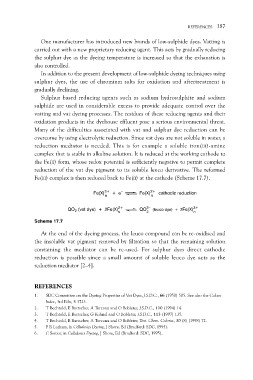
reduction mediator is needed. This is for example a soluble iron(III)-amine
complex that is stable in alkaline solution. It is reduced at the working cathode to
the Fe(II) form, whose redox potential is sufficiently negative to permit complete
reduction of the vat dye pigment to its soluble leuco derivative. The reformed
Fe(III) complex is then reduced back to Fe(II) at the cathode (Scheme 17.7).

Fe(X)3n+ + e–                                    Fe(X)2n+ cathodic reduction

                      QO2 (vat dye) + 2Fe(X)n2+  QO22– (leuco dye) + 2Fe(X)3n+
Scheme 17.7

   At the end of the dyeing process, the leuco compound can be re-oxidised and
the insoluble vat pigment removed by filtration so that the remaining solution
containing the mediator can be re-used. For sulphur dyes direct cathodic
reduction is possible since a small amount of soluble leuco dye acts as the
reduction mediator [2–4].

REFERENCES

1. SDC Committee on the Dyeing Properties of Vat Dyes, J.S.D.C., 66 (1950) 505. See also the Colour
        Index, 3rd Edn, 3 3723.

2. T Bechtold, E Burtscher, A Turcanu and O Bobleter, J.S.D.C., 110 (1994) 14.
3. T Bechtold, E Burtscher, G Kuhnel and O Bobleter, J.S.D.C., 113 (1997) 135.
4. T Bechtold, E Burtscher, A Turcanu and O Bobleter, Text. Chem. Colorist, 30 (8) (1998) 72.
5. F R Latham, in Cellulosics Dyeing, J Shore, Ed (Bradford: SDC, 1995).
6. C Senior, in Cellulosics Dyeing, J Shore, Ed (Bradford: SDC, 1995).

