


Page 403 - Basic Principles of Textile Coloration
P. 403
Dye absorption/mmol kg–1392 CATIONIC DYES

                              100

                               80

                               60

                               40
                                                                                                            (a)
                                                                                                            (b)

                               20
                                    2 4 6 8 10
                                                                            pH

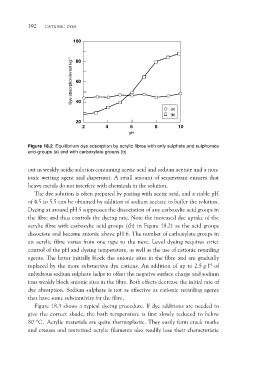
Figure 18.2 Equilibrium dye adsorption by acrylic fibres with only sulphate and sulphonate
end-groups (a) and with carboxylate groups (b)

out in weakly acidic solution containing acetic acid and sodium acetate and a non-
ionic wetting agent and dispersant. A small amount of sequestrant ensures that
heavy metals do not interfere with chemicals in the solution.

   The dye solution is often prepared by pasting with acetic acid, and a stable pH
of 4.5 to 5.5 can be obtained by addition of sodium acetate to buffer the solution.
Dyeing at around pH 5 suppresses the dissociation of any carboxylic acid groups in
the fibre and thus controls the dyeing rate. Note the increased dye uptake of the
acrylic fibre with carboxylic acid groups ((b) in Figure 18.2) as the acid groups
dissociate and become anionic above pH 6. The number of carboxylate groups in
an acrylic fibre varies from one type to the next. Level dyeing requires strict
control of the pH and dyeing temperature, as well as the use of cationic retarding
agents. The latter initially block the anionic sites in the fibre and are gradually
replaced by the more substantive dye cations. An addition of up to 2.5 g l–1 of
anhydrous sodium sulphate helps to offset the negative surface charge and sodium
ions weakly block anionic sites in the fibre. Both effects decrease the initial rate of
dye absorption. Sodium sulphate is not as effective as cationic retarding agents
that have some substantivity for the fibre.

   Figure 18.3 shows a typical dyeing procedure. If dye additions are needed to
give the correct shade, the bath temperature is first slowly reduced to below
80 °C. Acrylic materials are quite thermoplastic. They easily form crack marks
and creases and texturised acrylic filaments also readily lose their characteristic

