


Page 63 - Basic Principles of Textile Coloration
P. 63
52 SYNTHETIC FIBRES

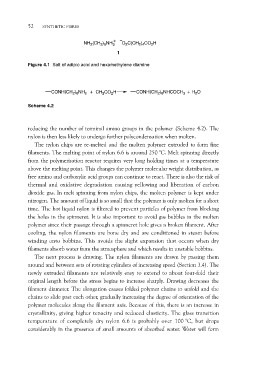
                                     NH2(CH2)6NH3 O2C(CH2)4CO2H
                                                           1

Figure 4.1 Salt of adipic acid and hexamethylene diamine

               CONH(CH2)6NH2 + CH3CO2H  CONH(CH2)6NHCOCH3 + H2O
Scheme 4.2

reducing the number of terminal amino groups in the polymer (Scheme 4.2). The
nylon is then less likely to undergo further polycondensation when molten.

   The nylon chips are re-melted and the molten polymer extruded to form fine
filaments. The melting point of nylon 6.6 is around 250 °C. Melt spinning directly
from the polymerisation reactor requires very long holding times at a temperature
above the melting point. This changes the polymer molecular weight distribution, as
free amino and carboxylic acid groups can continue to react. There is also the risk of
thermal and oxidative degradation causing yellowing and liberation of carbon
dioxide gas. In melt spinning from nylon chips, the molten polymer is kept under
nitrogen. The amount of liquid is so small that the polymer is only molten for a short
time. The hot liquid nylon is filtered to prevent particles of polymer from blocking
the holes in the spinneret. It is also important to avoid gas bubbles in the molten
polymer since their passage through a spinneret hole gives a broken filament. After
cooling, the nylon filaments are bone dry and are conditioned in steam before
winding onto bobbins. This avoids the slight expansion that occurs when dry
filaments absorb water from the atmosphere and which results in unstable bobbins.

   The next process is drawing. The nylon filaments are drawn by passing them
around and between sets of rotating cylinders of increasing speed (Section 3.4). The
newly extruded filaments are relatively easy to extend to about four-fold their
original length before the stress begins to increase sharply. Drawing decreases the
filament diameter. The elongation causes folded polymer chains to unfold and the
chains to slide past each other, gradually increasing the degree of orientation of the
polymer molecules along the filament axis. Because of this, there is an increase in
crystallinity, giving higher tenacity and reduced elasticity. The glass transition
temperature of completely dry nylon 6.6 is probably over 100 °C, but drops
considerably in the presence of small amounts of absorbed water. Water will form

