


Page 68 - Basic Principles of Textile Coloration
P. 68
NYLON FIBRES 57

readily on washing. This type of generalisation is useful but it may not always be
valid as there are considerable variations of each type of nylon, all with different
dyeing and fastness characteristics.

4.2.4 Other nylons
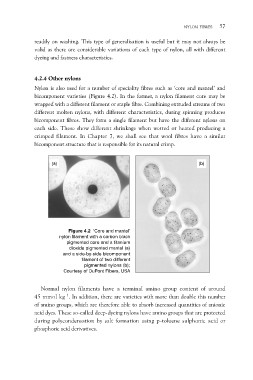
Nylon is also used for a number of speciality fibres such as ‘core and mantel’ and
bicomponent varieties (Figure 4.2). In the former, a nylon filament core may be
wrapped with a different filament or staple fibre. Combining extruded streams of two
different molten nylons, with different characteristics, during spinning produces
bicomponent fibres. They form a single filament but have the different nylons on
each side. These show different shrinkage when wetted or heated producing a
crimped filament. In Chapter 7, we shall see that wool fibres have a similar
bicomponent structure that is responsible for its natural crimp.

           (a) (b)

                      Figure 4.2 ‘Core and mantel’
                nylon filament with a carbon black

                     pigmented core and a titanium
                       dioxide pigmented mantel (a)

                  and a side-by-side bicomponent
                               filament of two different
                                 pigmented nylons (b);

                   Courtesy of DuPont Fibers, USA

   Normal nylon filaments have a terminal amino group content of around
45 mmol kg–1. In addition, there are varieties with more than double this number
of amino groups, which are therefore able to absorb increased quantities of anionic
acid dyes. These so-called deep-dyeing nylons have amino groups that are protected
during polycondensation by salt formation using p-toluene sulphonic acid or
phosphoric acid derivatives.

