


Page 66 - Basic Principles of Textile Coloration
P. 66
NYLON FIBRES 55

number of amino groups, but, in a regular nylon, the sum of amino (40 mmol kg–1)
and acetylamino end groups (55 mmol kg–1) approximately equals that for the
carboxylic acid groups.

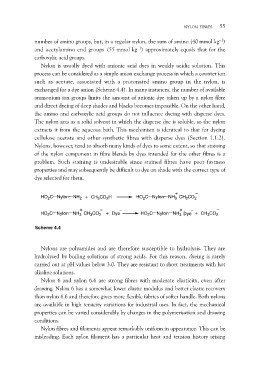
   Nylon is usually dyed with anionic acid dyes in weakly acidic solution. This
process can be considered as a simple anion exchange process in which a counter ion
such as acetate, associated with a protonated amino group in the nylon, is
exchanged for a dye anion (Scheme 4.4). In many instances, the number of available
ammonium ion groups limits the amount of anionic dye taken up by a nylon fibre
and direct dyeing of deep shades and blacks becomes impossible. On the other hand,
the amino and carboxylic acid groups do not influence dyeing with disperse dyes.
The nylon acts as a solid solvent in which the disperse dye is soluble, so the nylon
extracts it from the aqueous bath. This mechanism is identical to that for dyeing
cellulose acetate and other synthetic fibres with disperse dyes (Section 1.1.2).
Nylons, however, tend to absorb many kinds of dyes to some extent, so that staining
of the nylon component in fibre blends by dyes intended for the other fibres is a
problem. Such staining is undesirable since stained fibres have poor fastness
properties and may subsequently be difficult to dye on shade with the correct type of
dye selected for them.

   HO2C Nylon NH2 + CH3CO2H     HO2C Nylon NH3 CH3CO2
   HO2C Nylon NH3 CH3CO2 + Dye     HO2C Nylon NH3 Dye + CH3CO2
Scheme 4.4

   Nylons are polyamides and are therefore susceptible to hydrolysis. They are
hydrolysed by boiling solutions of strong acids. For this reason, dyeing is rarely
carried out at pH values below 3.0. They are resistant to short treatments with hot
alkaline solutions.

   Nylon 6 and nylon 6.6 are strong fibres with moderate elasticity, even after
drawing. Nylon 6 has a somewhat lower elastic modulus and better elastic recovery
than nylon 6.6 and therefore gives more flexible fabrics of softer handle. Both nylons
are available in high tenacity variations for industrial uses. In fact, the mechanical
properties can be varied considerably by changes in the polymerisation and drawing
conditions.

   Nylon fibres and filaments appear remarkably uniform in appearance. This can be
misleading. Each nylon filament has a particular heat and tension history arising

