


Page 83 - Basic Principles of Textile Coloration
P. 83
72 NATURAL CELLULOSIC FIBRES

   The complex arrangement of cellulose fibrils leads to a fibre structure of uneven
accessibility. Dye absorption tends to be greatest on the inside surface of the
curved bean-shaped cross-section and least on the ends. These differences in dye
absorption are evident on microscopic examination of cross-sections of dyed fibres
and illustrate the great heterogeneity of cotton. Fortunately, they are not visible to
the human eye [3].

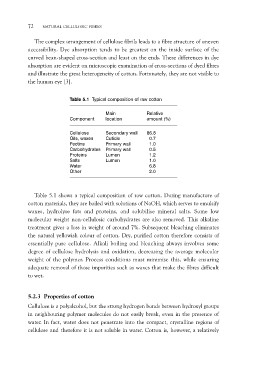
Table 5.1 Typical composition of raw cotton

Component      Main            Relative
               location        amount (%)

Cellulose      Secondary wall  86.8
Oils, waxes    Cuticle          0.7
Pectins        Primary wall     1.0
Carbohydrates  Primary wall     0.5
Proteins       Lumen            1.2
Salts          Lumen            1.0
Water                           6.8
Other                           2.0

   Table 5.1 shows a typical composition of raw cotton. During manufacture of
cotton materials, they are boiled with solutions of NaOH, which serves to emulsify
waxes, hydrolyse fats and proteins, and solubilise mineral salts. Some low
molecular weight non-cellulosic carbohydrates are also removed. This alkaline
treatment gives a loss in weight of around 7%. Subsequent bleaching eliminates
the natural yellowish colour of cotton. Dry, purified cotton therefore consists of
essentially pure cellulose. Alkali boiling and bleaching always involves some
degree of cellulose hydrolysis and oxidation, decreasing the average molecular
weight of the polymer. Process conditions must minimise this, while ensuring
adequate removal of those impurities such as waxes that make the fibres difficult
to wet.

5.2.3 Properties of cotton
Cellulose is a polyalcohol, but the strong hydrogen bonds between hydroxyl groups
in neighbouring polymer molecules do not easily break, even in the presence of
water. In fact, water does not penetrate into the compact, crystalline regions of
cellulose and therefore it is not soluble in water. Cotton is, however, a relatively

