


Page 78 - Basic Principles of Textile Coloration
P. 78
ACRYLIC FIBRES 67

that differ in dyeability. PAN fibres are hydrophobic (regain 1–3%) and can also be
dyed with disperse dyes by the solution mechanism. The disperse dyes, however, only
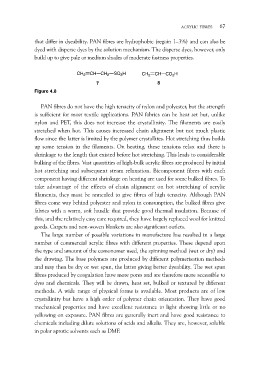
build up to give pale or medium shades of moderate fastness properties.

            CH2 CH CH2 SO3H  CH2 CH CO2H
                        7              8

Figure 4.8

   PAN fibres do not have the high tenacity of nylon and polyester, but the strength
is sufficient for most textile applications. PAN fabrics can be heat set but, unlike
nylon and PET, this does not increase the crystallinity. The filaments are easily
stretched when hot. This causes increased chain alignment but not much plastic
flow since the latter is limited by the polymer crystallites. Hot stretching thus builds
up some tension in the filaments. On heating, these tensions relax and there is
shrinkage to the length that existed before hot stretching. This leads to considerable
bulking of the fibres. Vast quantities of high-bulk acrylic fibres are produced by initial
hot stretching and subsequent steam relaxation. Bicomponent fibres with each
component having different shrinkage on heating are used for some bulked fibres. To
take advantage of the effects of chain alignment on hot stretching of acrylic
filaments, they must be annealed to give fibres of high tenacity. Although PAN
fibres come way behind polyester and nylon in consumption, the bulked fibres give
fabrics with a warm, soft handle that provide good thermal insulation. Because of
this, and the relatively easy care required, they have largely replaced wool for knitted
goods. Carpets and non-woven blankets are also significant outlets.

   The large number of possible variations in manufacture has resulted in a large
number of commercial acrylic fibres with different properties. These depend upon
the type and amount of the comonomer used, the spinning method (wet or dry) and
the drawing. The base polymers are produced by different polymerisation methods
and may then be dry or wet spun, the latter giving better dyeability. The wet spun
fibres produced by coagulation have more pores and are therefore more accessible to
dyes and chemicals. They will be drawn, heat set, bulked or textured by different
methods. A wide range of physical forms is available. Most products are of low
crystallinity but have a high order of polymer chain orientation. They have good
mechanical properties and have excellent resistance to light showing little or no
yellowing on exposure. PAN fibres are generally inert and have good resistance to
chemicals including dilute solutions of acids and alkalis. They are, however, soluble
in polar aprotic solvents such as DMF.

