


Page 90 - Basic Principles of Textile Coloration
P. 90
CELLULOSE 79

solution. Glucose therefore readily gives some reactions typical of aldehydes, such
as easy reduction of copper(II) or silver(I) ion complexes, or derivative formation
with hydrazines.

   One end of a cellulose molecule ends in a C-1 hydroxyl group and can form a
terminal aldehyde group like glucose. Cellulose is therefore a reducing agent, but a
weak one since the number of such reducing end groups is limited. Because of this,
dyeing of cellulosic fibres with some azo dyes at high temperatures under weakly
alkaline conditions is not always feasible. The aldehyde of the reducing end group
can reduce the azo dye, destroying its colour. This problem is more serious for
regenerated cellulosic fibres since they have a considerably lower DP and therefore
a higher proportion of potential aldehyde end groups. There are a number of
chemical tests that are used to establish the reducing power of cellulose. They
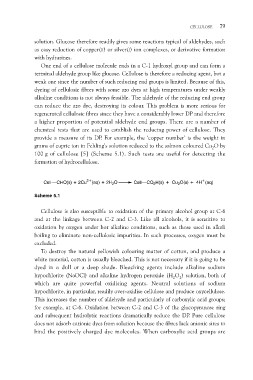
provide a measure of its DP. For example, the ‘copper number’ is the weight in
grams of cupric ion in Fehling’s solution reduced to the salmon coloured Cu2O by
100 g of cellulose [5] (Scheme 5.1). Such tests are useful for detecting the
formation of hydrocellulose.

      Cell CHO(s) + 2Cu2+(aq) + 2H2O  Cell CO2H(s) + Cu2O(s) + 4H+(aq)
Scheme 5.1

   Cellulose is also susceptible to oxidation of the primary alcohol group at C-6
and at the linkage between C-2 and C-3. Like all alcohols, it is sensitive to
oxidation by oxygen under hot alkaline conditions, such as those used in alkali
boiling to eliminate non-cellulosic impurities. In such processes, oxygen must be
excluded.

   To destroy the natural yellowish colouring matter of cotton, and produce a
white material, cotton is usually bleached. This is not necessary if it is going to be
dyed in a dull or a deep shade. Bleaching agents include alkaline sodium
hypochlorite (NaOCl) and alkaline hydrogen peroxide (H2O2) solution, both of
which are quite powerful oxidising agents. Neutral solutions of sodium
hypochlorite, in particular, readily over-oxidise cellulose and produce oxycellulose.
This increases the number of aldehyde and particularly of carboxylic acid groups;
for example, at C-6. Oxidation between C-2 and C-3 of the glucopyranose ring
and subsequent hydrolytic reactions dramatically reduce the DP. Pure cellulose
does not adsorb cationic dyes from solution because the fibres lack anionic sites to
bind the positively charged dye molecules. When carboxylic acid groups are

